



Five childless old women hatch a goose egg -- but what comes out is no gosling.
Mumle Goose-Egg is a classic Norwegian folktale as recorded in the 1800s in the collection of Peter Christen Asbjørnsen and Jørgen Moe (Norwegian Folktales). The story belongs to the tradition of supernatural trials, trolls, and cunning heroes who turn strength and quick wit to their advantage. Below, the tale follows in four parts with subheadings to help the reader find their way through the action.
Part One – A Goose Egg Hatches an Unusual Hero
Once upon a time there were five old women out cutting corn in a field; all of them were childless, and all of them longed for a child of their own. Just then they came upon an unreasonably large goose egg, nearly as big as a man's head.
"I saw it first," said one.
"I saw it just as soon as you did," cried another.
"I'll have it for sure, for I was the first to see it," swore the third. So they carried on, and grew so quarrelsome over the egg that they very nearly came to blows.
But then they agreed that all five should own it together, and that they would sit on it, the way a goose does, and hatch out the gosling. The first one lay on it for eight days, brooding and idling and doing nothing at all; meanwhile the others had to slave away fetching food for themselves and for her too. At last one of them gave her a piece of her mind for it.
"You didn't come out of the egg able to peep either, you know," said the one who lay brooding; "but I think this is more likely to turn out human, for I can hear it muttering in there, over and over: 'Herring and porridge, gruel and milk,'" she said; "now you can lie on it for eight days, and then we'll take turns hauling the food to you."
When the fifth one, too, had lain on it for eight days, she heard clearly that there was a child inside the egg, crying out for
"herring and porridge, gruel and milk"
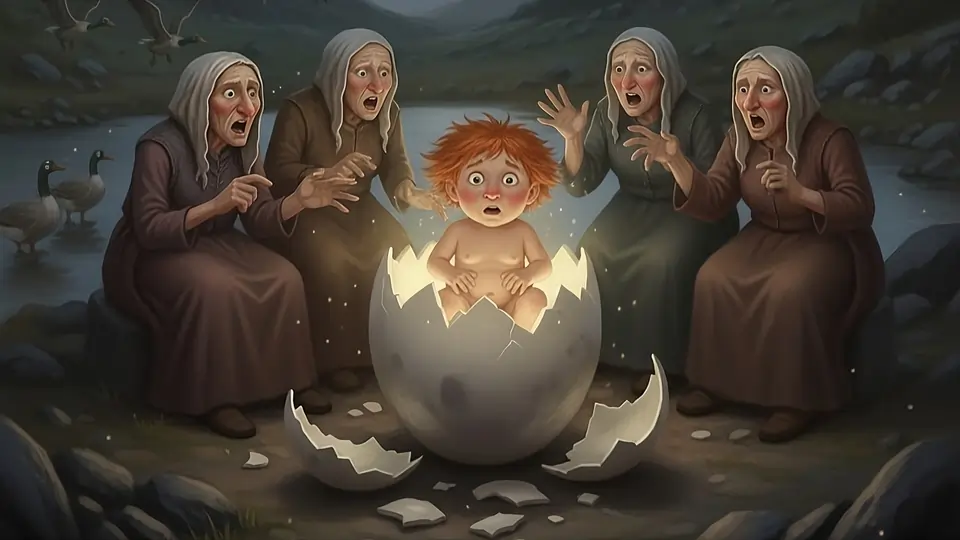
and so she pecked a hole in it; but instead of a gosling, out came a human child, so dreadfully ugly he was, with a great head and a puny little body, and the very first thing he cried out for, the moment he came out, was
"herring and porridge, gruel and milk." So they named him Mumle Goose-Egg.
Ugly as he was, they were fond of him at first all the same; but it wasn't long before he grew so greedy that he ate up every scrap of food they had. Whenever they cooked a pot of gruel or porridge that they thought would be plenty for all six of them, the child would gulp down the whole lot by himself. So they didn't want him any longer.
"I haven't felt full a single time since this changeling crawled out of the eggshell,"
said one of them, and when Mumle Goose-Egg heard that the others all agreed, he said he'd be glad to go his own way then; if they had no need of him, he had no need of them either, and off he went.
Part Two – From the Farmer's Field to the King's Trials
In time he came to a farm that lay in stony ground, and asked for work; they needed a hired hand there, and the farmer set him to clearing stones from the field. And Mumle Goose-Egg did gather stones from the field, taking ones so big that each would have made many a wagon-load, and whether they were big or small, he simply stuffed them into his pocket. It wasn't long before he'd finished the work, and then he wanted to know what he should do next.
"You'd better pick the rest of the stones out of the field," said the man; "surely you can't be done already, I'd think."
But Mumle Goose-Egg emptied his pockets and tipped the stones into a pile. Then the farmer saw that he'd finished the work after all, and understood he'd best be careful with someone so strong. He could come inside and have something to eat, the farmer said. Mumle Goose-Egg thought that sounded fine too, and he ate up alone what had been made for the whole household and the farmhands besides, and still he wasn't half full.
He was quite a hand for work, but he was a fearsome hand for eating too, for there seemed to be no bottom to him, the farmer thought.
"A workman like that could eat a poor farmer clean out of house and home before he even knew it," he said.
He had no more work for him; the fellow had best go to the king's estate.
Mumle Goose-Egg made his way to the king, and found a place at once; at the king's estate there was food and work enough. He was to be an errand boy and help the maids carry wood and water and do other small chores.
So he asked what he should do first.
He could split a bit of firewood for the time being, they told him.
Well, Mumle Goose-Egg set to splitting and chopping so the chips flew all around him; it wasn't long before he'd chopped up everything there was, both firewood and timber, both sawlogs and rough planks, and once he was done with that, he came and asked what he should turn his hand to now.
"You can go chop yourself some more wood now," they said.
"There's nothing left to chop," said Mumle Goose-Egg.
That couldn't be true, thought the steward, and went out to look for himself. But sure enough, Mumle Goose-Egg had chopped up everything there was; it had all become firewood, sawlogs and long timber alike. This annoyed him no end, and he told Mumle Goose-Egg he'd get no food until he'd been out to the forest and felled just as much timber as he'd chopped into firewood.
Mumle Goose-Egg went to the smithy, and got the smith to help him make an axe out of fifteen hundredweight of iron. Then he set off for the timber forest and began felling wholesale; down went both tall spruces and mast-pines, everything he came across, on the king's land and the neighbor's alike; he neither trimmed the branches nor topped the trunks, so it all lay there like the wreckage of a storm. Then he loaded a proper load onto the sledge and hitched up all the horses; but they couldn't budge it an inch, and when he grabbed them by the head to get it moving, he pulled their heads clean off; so he tipped the horses out of the shafts and up onto the field, and hauled the load home by himself.
When he got back to the king's estate, the king and his timber-steward stood in the gallery ready to receive him, for the steward had been out there and seen what a mess he'd made of the forest. But when Mumle Goose-Egg came dragging home half the timber forest behind him, the king grew both angry and afraid, and thought he'd best go carefully with someone so strong.
"That's a fearsome workman indeed," said the king; "but how much do you eat at a sitting?" he asked. "For I expect you must be hungry by now."
When he was to have a proper bowl of porridge, it took twelve barrels of flour, said Mumle Goose-Egg; but once he'd got that down him, he could hold out for quite a while.
It took time to cook a porridge like that, and meanwhile he was to fetch in some firewood for the cook. He loaded the whole woodpile onto a sledge, but when he tried to get it through the door, he was careless again. The whole house came apart at every joint, and it was a near thing that he didn't pull the entire estate down. When the food was nearly ready, they sent him out to call the people in. He shouted so loud it echoed off every crag and hill; but they didn't come quickly enough for his liking, so he lost his temper with them and killed twelve of them on the spot.
"He's killed twelve," said the king, "and he eats more than twelve times over — but how many men's work do you do?"
"That's more than twelve times over too," said Mumle.
Once he'd eaten, he was to go to the barn and thresh; so he took down the ridge-beam and made a threshing-flail of it, and when the roof began to fall in because of it, he took a great trimmed spruce trunk and set it up as a new ridge-beam, and then he threshed the grain and the straw and the hay all together. It did no end of damage, for the chaff flew about everywhere and hung like a cloud over the whole estate.
Just as he was nearly finished with the threshing, enemies came into the land, and there was to be war. So the king told him he could take men with him and go meet the enemy and fight; for he thought surely they'd kill him this time. No, he wouldn't have any men worn down on his account, he'd fight alone, said Mumle Goose-Egg.
All the better, then I'll be rid of him all the sooner, thought the king.
But he'd need a proper club.
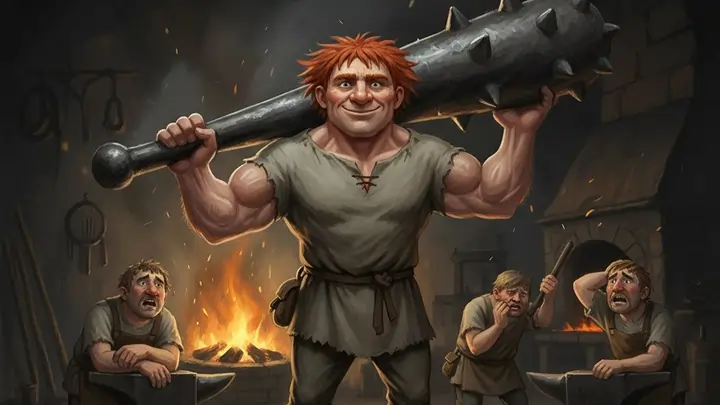
They sent word to the smith; he forged one weighing five hundredweight. That might do to crack nuts with, said Mumle Goose-Egg. So he forged one of fifteen hundredweight; that might do to peg shoes with, said Mumle. Well, the smith and his men couldn't forge one any bigger than that. So Mumle Goose-Egg went to the smithy himself, and made a club of fifteen shippounds, one that would have taken a hundred men to even lift off the ground. That one, thought Mumle Goose-Egg, might just about do. Then he needed a food-sack too; they made it out of fifteen ox-hides and packed it full of food, and off he trudged down the hillside, with the sack on his back and the club over his shoulder.
When he'd come close enough for the enemy soldiers to see him, they sent one man out to ask if he'd surrender.
"Just wait till I've had a bite to eat," said Mumle Goose-Egg, and threw himself down on the ground and settled behind his great food-sack to eat.
But they wouldn't wait; they opened fire on him at once, so that bullets rained and hailed down on him.
"These little berries don't bother me," said Mumle Goose-Egg, and went on eating even more;
neither lead nor iron so much as scratched him, and the food-sack stood in front of him and took the bullets like a proper rampart.
So then they took to hurling bombs and firing cannon. He winced a little at every blast he took.
"That doesn't trouble me much," he said.
But then a bomb landed right in his throat.
"Ugh!" he said, and spat it back out,
and then a chain-shot went clean through his food-tin, and another one snatched the mouthful right out from between his fingers.
That made him angry; he stood up, swung his great club down on the ground, and asked whether they meant to take the very food from his mouth with those little blueberries they blew out of their thin little pipes. He struck a few more blows, so hard the crags and hills rumbled, and the enemy scattered into the air like chaff — and that was the end of that war.
Part Three – Rent from Hell, and Grandfather's Sword at the Sea-Castle
When he came home again and wanted more work, the king grew truly uneasy, for by now he'd been sure he was rid of him. He could think of no other way out than to send him down to hell.
"You'd best go to Old Erik and collect the rent that's owed me," he said.
Off went Mumle Goose-Egg, with the sack on his back and the club over his shoulder; he wasn't long on the road; but when he got there, Old Erik was out holding an inquest. No one else was home but his mother, and she said she'd never heard tell of any rent, he'd have to come back another time.
"Well then, come to me tomorrow!" he said;
he meant it as a lie; if he'd only come, he could very well stay there, and bring the rent with him besides — he had plenty of time to wait. But once Mumle had eaten up his provisions, the time began to drag, so he demanded the rent from the old mother again, and told her she'd best hand it over now.
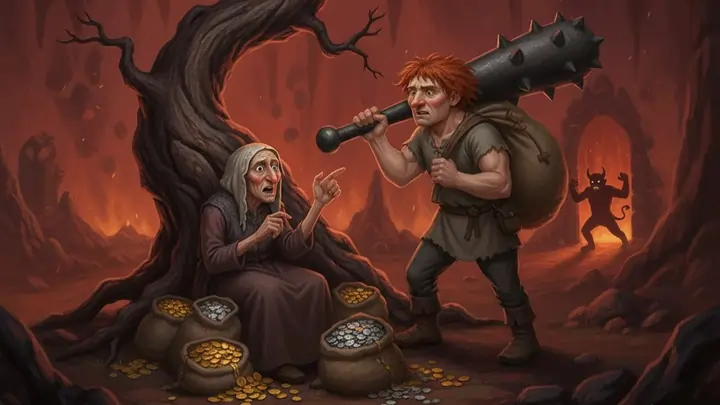
No, that she would not; her word stood as firm as the old pine tree, she said, the one that stood outside the gates of hell, so huge that fifteen men could scarcely reach around it. But Mumle climbed straight up to the top of it and twisted and wrung it about like a willow switch, and asked whether she wouldn't pay up the rent now.
Well, then she didn't dare do otherwise, and scraped together as many coins as he reckoned he could carry in his great sack. So he set off for home with the rent, and no sooner had he left than Old Erik came home. When he heard that Mumle had made off with the great sack full of money, he thrashed his mother first, and then set off after him at a run to catch him.
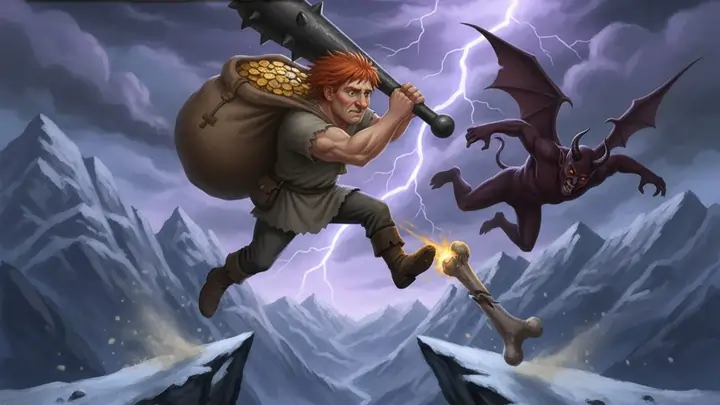
And he very nearly did catch him too, for he ran like the wind and flew along at times, and Mumle, weighed down by his heavy sack, could barely keep to the ground; but with Old Erik right on his heels, he began to leap and bound as best he could, holding the club behind him to fend the fellow off.
And so it went; Mumle held the shaft, and Old Erik grabbed and clawed after the club, until they came to a deep valley; there Mumle leapt from one crag over to the other, and Old Erik was so hot on the chase that he ran straight into the club, tumbled down into the valley, and broke one of his legs — and there he lay.
"There's your rent for you," said Mumle Goose-Egg, when he got back to the king's estate, and flung the money-sack down at the king so hard it thundered in the gallery.
The king thanked him kindly and promised him good wages and safe passage home, if that was what he wanted; but Mumle Goose-Egg only wanted more work.
"What shall I do now?" he asked.
Well, once the king had thought it over, he said Mumle could go to the mountain troll who had taken his grandfather's sword, at the castle he had by the sea, a place no one dared go near.
Mumle took a few days' provisions in his great sack and set off again, and he walked long and far, over forest and fell and wild moorland, until he came to some great crags where the troll was said to live, the one who'd taken the king's grandfather's sword.
But the troll was nowhere out in the open, and the mountain was sealed shut, so Mumle had no way in.
So he joined up with some quarrymen who lived on a mountain farm nearby and spent their days breaking stone up among those crags. They'd never had such help before, for he broke and struck at the rock so hard that the mountainside split and great boulders came tumbling down like houses; but when he sat down at midday to have some of the first sack of food, he found it had all been eaten already.
"I've a fair appetite myself," said Mumle, "but whoever's been here is worse for eating than I am, for he's eaten the bone as well," he said.
So it went the first day, and no better the second. On the third day he set off to break rock again, and brought along the third sack of food, but this time he lay down behind it, as though he were asleep.
Just then, out of the mountain came a troll with seven heads, and set to smacking his lips and eating up his food.
"Now it's all laid out ready, now I'll eat," said the troll.
"We'll fight over that!" said Mumle, and struck with his club so that all the heads went rolling.
Then he went into the mountain the troll had come out of, and inside stood a horse eating from a barrel of glowing embers, with a barrel of oats standing behind it.
"Why don't you eat from the oat-barrel?" said Mumle Goose-Egg.
"Because I'm not able to turn myself around," said the horse.
"I'll turn you around soon enough," said Mumle.
"You'd best tear my head off instead," said the horse.
So he did just that, and the horse turned into a handsome young man. He said he'd been mountain-taken and turned into a horse by the troll, and he helped Mumle find the sword, which the troll had hidden beneath the bed, and there in the bed lay the troll's old mother, snoring away.
They set off home over the water, and once they were out on it, the old troll-hag came after them. She couldn't catch up with them, so she set to drinking, and drank until the water sank and shrank away; but the sea was more than she could manage to drink dry — and so she burst.
When they reached land, Mumle Goose-Egg sent word for the king to come fetch the sword. He sent four horses, but they couldn't so much as budge it; he sent eight, and he sent twelve, but the sword stayed right where it was — they couldn't shift it an inch. But Mumle Goose-Egg picked it up alone and carried it home.
Part Four – The Troll Castle, the Bridge over the Sound, and the King's Fate
The king could hardly believe his own eyes when he saw Mumle again, but he spoke him fair and promised him gold and green forests; and when Mumle wanted still more work, the king said he could go out to the troll castle he owned, the one no one dared set foot in, and stay there until he'd built a bridge over the sound, so folk could reach it; if he managed that, the king would reward him well, and would even gladly give him his daughter, he said.
Yes, he thought he could manage that well enough, said Mumle Goose-Egg.
No one had ever come back from there alive; those who'd made it that far lay there, killed and picked apart down to crumbs, and the king thought he'd surely never see him again, once he had him out there.
But Mumle set off; he took with him his food-sack and a suitably gnarled and twisted pine log, a splitting-axe, a wedge, and a few resin-sticks, and along with him he brought the poor parish boy from the king's estate.
When he came to the sound, the river ran thick with ice and was as fierce as a waterfall; but he planted his feet on the bottom and waded across, and made it over at last.
Once he'd warmed himself and had something to eat, he wanted to sleep; but it wasn't long before there came such a crashing and roaring it seemed the whole castle would be turned upside down. The door flew wide open, and all he could see was a gaping maw stretching from the doorsill up to the door-beam.
"There's a mouthful for you, taste that," said Mumle, and threw the parish boy straight into the gaping jaws. "Now let's see what sort you are — perhaps we know each other?"
And indeed they did; for it was Old Erik come to pay a visit. They took to playing cards; he thought he might win back a bit of the rent Mumle had squeezed out of his mother when he'd come collecting for the king. But however it went, it was Mumle who won, for he'd marked the best cards with a cross, and once he'd won everything Erik had on him, Old Erik had to hand over some of the gold and silver kept at the castle.
Just then their fire went out, so they could no longer tell the cards apart.
"Well, we'd best chop some wood then," said Mumle, and drove his splitting-axe into the pine log and hammered in the wedge, but the twisted old log was stubborn and wouldn't split at once, no matter how Mumle wrenched and worked at it with the axe.
"They say you're supposed to be strong," he said to Old Erik; "spit in your hands, dig your claws in, wrench and pull, and let's see what you're good for!" he said.
Erik did just that, and dug both fists into the crack and pulled with all his might; but the very moment he did, Mumle knocked the wedge out, and Old Erik was caught fast in the pinch; after that Mumle tried the back of the axe-head across his back for good measure. Old Erik begged both softly and sweetly to be let loose, but Mumle Goose-Egg wouldn't hear a word of it, not until Erik swore he'd never come there to cause trouble again; and he had to promise besides that he'd build a bridge over the sound, so folk could cross at any time of year, and that it would be finished once the ice broke up.
"That was a hard bargain," said Old Erik.
But there was nothing else for it; if he wanted to be free, he had to promise. Though he did strike one condition — that he should have the first soul who crossed the bridge, as the toll for the crossing.
That he could have, said Mumle. So he let him go, and off he went home. But Mumle Goose-Egg lay down to sleep on it, and slept well on into the day.
When the king came to see whether he'd been chopped up or merely picked over a little, he had to wade through piles of money before he even reached the bed; it lay in heaps and sacks clear up the wall, and there in the bed lay Mumle, snoring away.
"God help me and my daughter both," he said, once he realized Mumle was alive and well.
Well, everything had certainly been done properly, no one could deny that; but there was no point talking about a wedding until the bridge was finished, he said.
Then one day, there stood the bridge, all finished, and Old Erik stood upon it, ready to collect the toll he'd bargained for.
Mumle Goose-Egg wanted to bring the king along to try the bridge, but the king had no wish to do that at all. So he mounted a horse himself, and slung the great, hulking dairymaid from the king's estate up onto the saddle-bow in front of him — she looked for all the world like an enormous pine log — and rode across so hard the bridge thundered under them.
"Where's the toll? Where's the soul?" shrieked Old Erik.
"She's sitting right here inside this pine log; if you want her, spit in your hand and come take her," said Mumle Goose-Egg.
"No, thanks all the same — if she won't take me, I won't take her," said Old Erik; "you've caught me in one trap already, you won't catch me in another," he said, and with that he flew straight home to his old mother, and from that day to this, no one has heard from him or asked after him there.
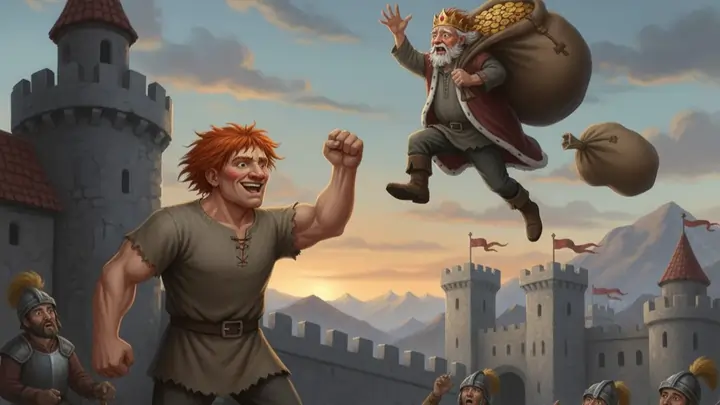
As for Mumle Goose-Egg, he made his way home to the king's estate to claim the wages the king had promised him, and when the king tried to wriggle out of paying and go back on his word, Mumle told him he'd best make himself a good sturdy sack, for he'd help himself to his wages then. Well, the king did just that, and once it was ready, Mumle took the king out onto the practice ground and gave him such a solid blow that he flew straight up into the air. Mumle threw the food-sack up after him too, so he wouldn't go hungry, and if he hasn't come back down since, then he's still floating somewhere between heaven and earth with his food-sack, to this very day.
THE END

The Moral – What Does Mumle Goose-Egg Teach Us?
- Wit and strength: Raw power alone is dangerous, but combined with cleverness it can serve justice. Mumle wins not just because he's strong, but because he's quick-witted (the card trick, the pine log, the bridge toll).
- Greed punishes itself: The king's attempts to use Mumle and be rid of him end with his own honor lost — and in the end he floats away as a warning against breaking one's word.
- Facing what's dangerous: Trolls, Old Erik, and war are all overcome when the hero dares to face the danger head-on and do what no one else will.
- Fairness and moderation: Mumle claims only the wages he's rightfully owed and makes sure the way (the bridge) is made safe for everyone — a picture of using one's gifts for the good of all.




 English
 Norsk
Norsk Svenska
 Dansk
Dansk Deutsch
 Nederlands