Hans trades away his hard-earned wages step by step -- gold for a horse, a horse for a cow -- and yet feels happier with every trade.
This is the Brothers Grimm's famous tale of Hans, a simple young man who returns home after many years of service -- but with nothing to show for it. The story shows how Hans trades away riches step by step, and still ends up feeling happy in the end. Read it aloud and enjoy a tale about choices, chance, and what truly makes someone content.
The Tale of Hans in Luck 🍀
👨🌾 Hans Leaves His Master
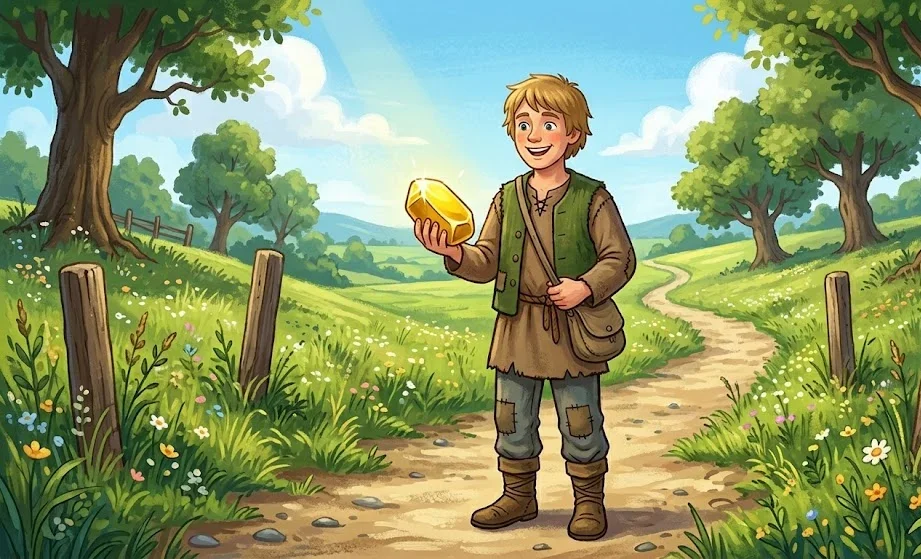
Hans had served a good master for seven years. He worked from morning until evening, carrying wood, spinning, and helping in the fields. On his last day, the master came to him with a bundle that glittered in the sunlight.
"Here is your wages, Hans; take it with all my heart."
said the master with a gentle smile, and placed a lump of gold in his palm. Hans felt the warm weight against his hand and thought at once of his mother and the old house back home.
He said his goodbyes and set off, light of heart. It was as if the sun itself walked ahead of him on the road. He hummed a tune as he carried the lump of gold in a bag. He was looking forward to seeing his mother and grandmother's old door again.
🐴 The First Trade: Gold for a Horse
Not long after, Hans met a man with a strong horse. The man looked at the lump of gold and threw out his arms.
"You can't ride on gold. Take the horse instead, and you'll get home faster."
said the man, calm and friendly.
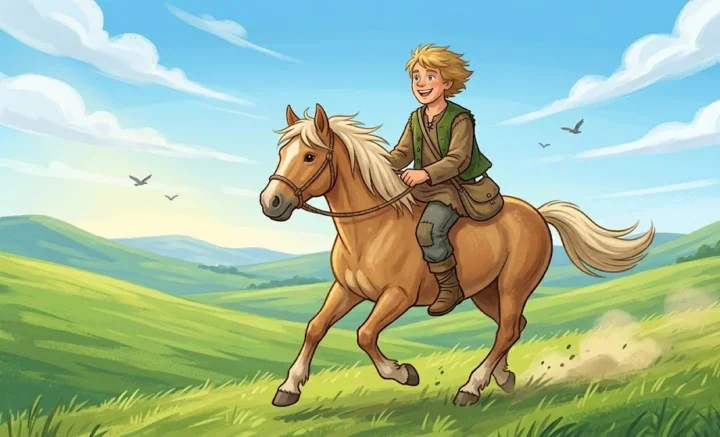
Hans thought about how tiring it was to walk. He pictured himself riding down the road, the wind in his hair. So he traded the gold for the horse without a moment's hesitation. The horse was soft and warm beneath him, and Hans sang even louder with joy.
🐄 From Horse to Cow, from Cow to Pig
A little further on, Hans met a farmer who thought the horse was too wild. Hans felt a little uneasy whenever the horse tossed its head, and he began wishing for something simpler to bring along.
"This horse won't listen. Trade it for my cow, and you'll have milk along the way instead of having to ride."
offered the farmer, and Hans thought that sounded sensible. He traded the horse for a calm cow. The cow's flank was warm, and it chewed grass slowly while Hans patted it.
Not long after, he met another man coming home from the market with a big, happy pig. The pig could find food anywhere, the man said.
"A pig is easy to bring along, it finds its own food. Take it instead of the cow."
Hans thought a pig would make walking easier, so he traded. He chuckled to himself at how many trades he'd already made, but he was pleased every time -- each one seemed like a good idea at the moment.
🪶 From Pig to Goose, from Goose to Grindstone
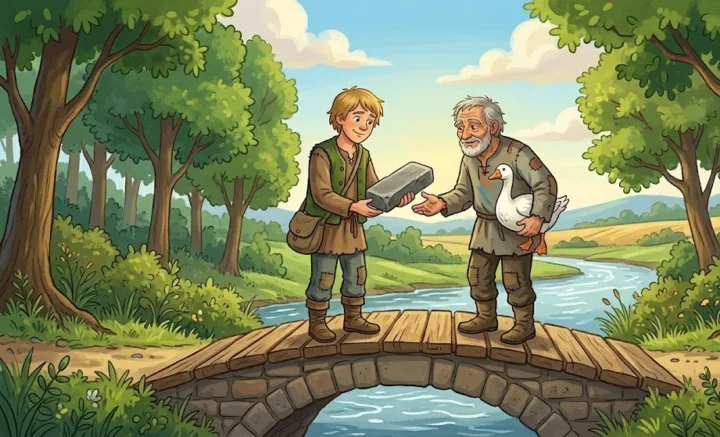
On a bridge, Hans met a bird seller. He held up a heavy, handsome goose that flapped its wings.
"Give me the pig, and I'll give you this goose. It gives meat and eggs and won't cause you any worry."
said the seller, smiling beneath his scarf.
Hans found the goose fun to hold. It stretched toward his pocket and poked its beak at his jacket. He made the trade, and walked on along the river with the goose honking beside him.
After a while, an old man came along with a large, heavy stone he said was a grindstone. The man explained that a grindstone could bring work and money for life -- one could sharpen knives and earn a few coins.
"The goose will fly off when you least expect it. Take this grindstone instead; it's heavy, but useful."
Hans thought a stone would make him into a useful man, so he traded the goose for the grindstone. Now he carried something he could barely lift, but he smiled and believed it had been a clever choice.
💧 The Grindstone and the Well
With the grindstone on his shoulder, Hans walked on. It was heavy and cut into his arms, but he thought about how he'd soon have work and perhaps earn some money. Along the way he came to a well with cold, clear water.
He sat down to rest and set the grindstone beside him. A cart came by, pulled by an old fellow who looked worn out. Hans saw how heavily the man struggled with his load, and he wanted to help.
"Oh, would you help me carry this load across the bridge? I have no strength left."
said the fellow, looking at him with tired eyes.
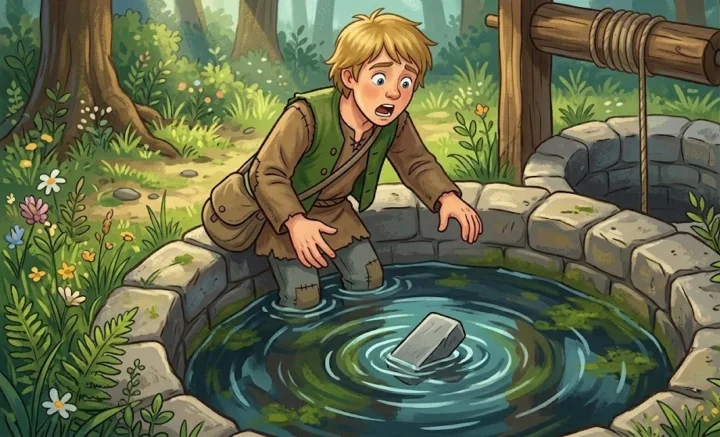
Hans wanted to help. He let the fellow take the grindstone to make the crossing lighter. But just as the fellow lifted the stone, he dropped it into the well with a splash.
Hans stood completely still. He watched the stone sink into the dark water; ripples spread out, and then it was gone. For a moment the world froze. Then the fellow stepped over and laid a hand on Hans's shoulder.
"That was bad luck," said the fellow, but his voice was gentle. He couldn't give the stone back. Hans felt his pockets were empty, but a sense of relief settled in his stomach. Now he had nothing left to carry.
🏡 Coming Home with Nothing -- and with Joy
As Hans neared the village, he brushed the dust from his jacket and sang again. He had no gold, no horse, no cow, no pig, no goose, and no stone. He had only himself and a light step to walk with.
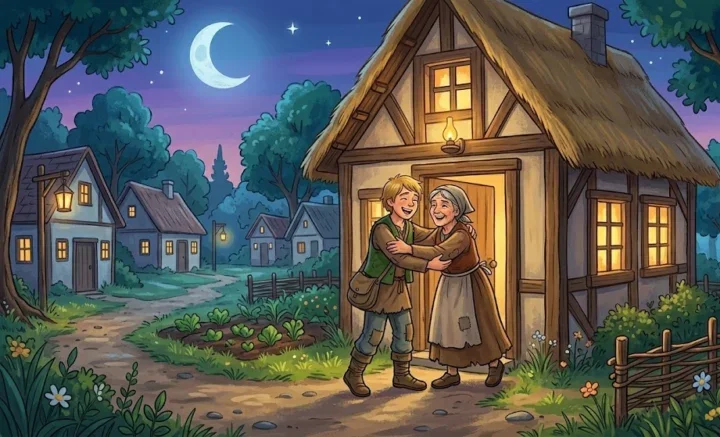
He opened the gate to the little house where his mother lived. She stood in the doorway with a scarf around her hair, and her face fell when she saw him without gifts or money.
"Oh, Hans! Come in, my son, but where is everything you promised to bring back?"
said his mother, her voice full of worry.
Hans stepped inside and smiled as warmly as he could. He wrapped his arms around his mother and held her close.
"I'm light of heart, mother. I have no burdens to carry, and I'm just as happy as a king."
he said, sincere and calm. His mother wiped her eyes and couldn't help laughing a little at her son's joy. Even though the house was humble, it felt like the richest place in the world that evening.
~ THE END ~
The Moral of Hans in Luck 💛
The story shows that happiness doesn't always lie in things. Hans chooses lightness, joy in the moment, and simplicity over possessions and burdens. The moral of "Hans in Luck" is that sometimes being free of worry gives more than gathering riches.
Questions About Hans in Luck
- Why did Hans trade away the lump of gold for a horse?
- Which trade do you think was the smartest -- horse, cow, pig, or goose? Why?
- What happened to the grindstone at the well, and how did Hans react?
- Would you have felt just as happy as Hans when he came home with nothing? Explain.
- Which choices in the story show that Hans prefers simplicity over possessions?

Curiosities About Hans in Luck 🏰
- "Hans in Luck" comes from German folktale tradition and was collected and published by the Brothers Grimm in their collection "Children's and Household Tales."
- The tale is often considered a chain or trading story: the hero makes several trades in sequence, a motif found in many folktales.
- In many English-language editions the story is called "Hans in Luck," and it's often described as an example of a folktale where the main character shows contentment over material gain.
- The story is short and simple, which has made it popular reading for children of preschool and early school age (around 5-10 years old).

 English
 Norsk
Norsk Svenska
 Dansk
Dansk Deutsch
 Nederlands