
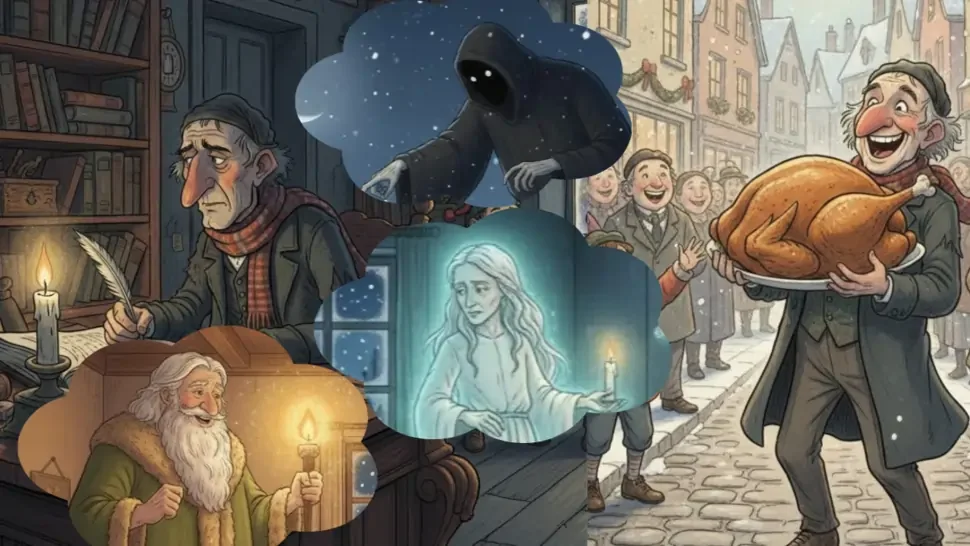
Ebenezer Scrooge despised Christmas, until Marley's ghost and three spirits showed him the past, the present, and the future -- and changed him forever.
A Christmas Carol is one of the most beloved and retold Christmas stories of all time. The tale has become a fixture of December for children and adults alike, and it's associated with warmth, togetherness, and true Christmas spirit. Even for new generations, A Christmas Carol is an encounter with tradition, morality, and a timeless reminder of what Christmas is really about.
The story was written by Charles Dickens in 1843, and it's still cherished today for its classic and historic significance. Dickens wanted to show how kindness, empathy, and consideration could transform both individuals and entire societies — a message that still touches readers around the world.
Now you can read the whole retold version below. We've adapted the language and pacing so children can experience the story in a warm and easy-to-follow way, without losing its original spirit. Join us from the very first page — Scrooge's journey begins here.
A Christmas Carol: The Full Retold Story
Want to jump to a specific part? Pick up right where you left off.
Stave I: Marley's Ghost 👻
Ebenezer Scrooge was a man who preferred cold to warmth. He hoarded everything, both money and kindness, as if every little smile cost a fortune. People in the street greeted him carefully when he walked by, for his face was as tight as the winter wind. Christmas? He thought it was nothing but humbug. A Christmas Carol about joy and warmth had no place in his world.
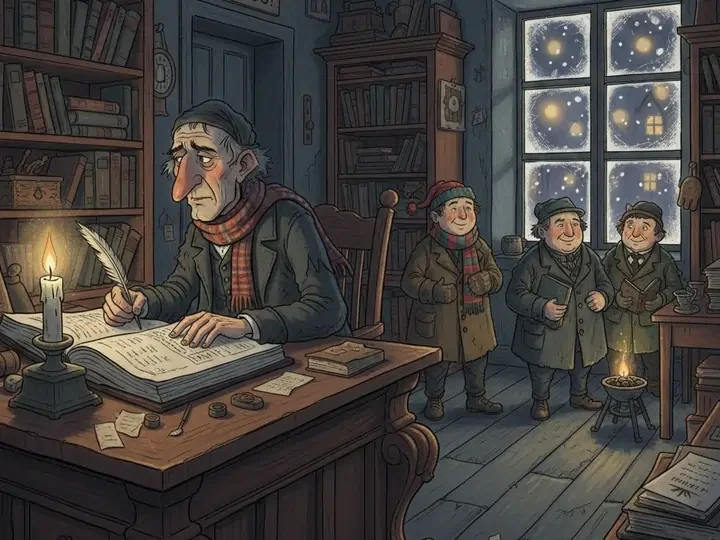
His office was as chilly as his mood. A small room, dark and drafty, where frost nearly settled on the windowpanes. In the middle of the cold sat the patient Bob Cratchit, writing with cold fingers. He hardly dared ask for more coal for the stove.
"More coal, sir? It's very cold today…"
Scrooge answered without looking up:
"More coal? Shall we melt away all our profits too?"
Bob nodded quietly and went on with his work, blowing warm breath onto his hands to keep them moving. That's how the day began at Scrooge's — with cold, silence, and no trace of Christmas cheer.
The day went on just as cold as always, until the door suddenly opened and his nephew Fred came in with a big smile. He carried with him the whole feeling of Christmas, warmth, and light — everything Scrooge would rather do without.
"Merry Christmas, Uncle!" Fred said cheerfully. "Christmas is a time for joy and hope."
Scrooge narrowed his eyes.
"Merry Christmas? Nothing but humbug and a waste of money."
Fred laughed gently, used to his uncle's ways, before wishing Bob a good day and leaving the office in the same good spirits he'd arrived in.
Shortly after, two gentlemen came in collecting money for the poor.
"Many people are struggling this Christmas. Might you spare a small contribution?"
Scrooge shook his head sharply.
"Those who can't manage should go to the workhouses. I give nothing."
The gentlemen thanked him politely but left the room clearly disappointed. That's how Scrooge turned everyone away — as cold as the winter outside.
As evening fell, Scrooge withdrew to his lonely house. It was big, old, and dark, as if it were holding its breath in the foggy air. After eating his sad dinner alone, he walked home, toward the heavy front door.
That's where the strange thing happened. The house had also been Marley's house, and the door-knocker was the same one. But just as Scrooge reached for the cold, heavy brass ring, he saw it change. It was no longer a door-knocker. It was the face of Jacob Marley. A ghostly face with staring, lifeless eyes.
Scrooge felt a cold jolt of disbelief.
"Humbug!" he muttered sharply, rubbing his eyes hard.
When he opened them again, there was only the old brass knocker there. This was the first sign of the supernatural, but Scrooge locked the door behind him with extra care and refused to believe what he had seen.
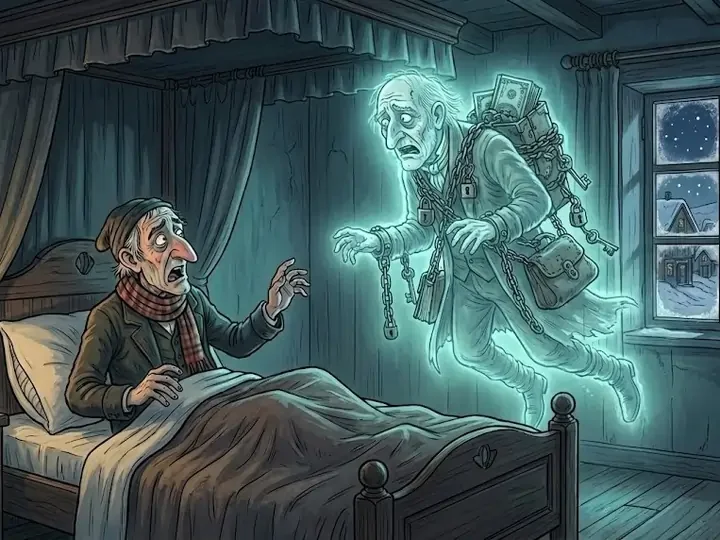
Scrooge locked the door and climbed the stairs, annoyed that he had to light an extra candle. He sat down in his cold room. Suddenly every bell in the house began to ring, followed by a heavy, dreadful sound from below — the sound of metal being dragged up the stairs. The door opened, and Jacob Marley stood there. He was transparent, but dressed in his old clothes. Around him he wore a long, rattling chain, fastened with ledgers, cash-boxes, and heavy safes.
"Tell me, spirit," Scrooge demanded, "why are you chained?"
"I wear the chain I forged in life," Marley answered in a hollow voice. "It is made of my greed and my lack of care for humankind. My punishment is to wander without rest and never be able to help."
Marley turned his suffering gaze to Scrooge. "I come with one last warning, Ebenezer. You carry a chain yourself, just as heavy and just as long. You will be haunted by three spirits; without their visits, you cannot escape my cursed fate."
Marley raised his frightening hand, and the terrible chain rattled in warning.
"The first spirit comes tomorrow, when the clock strikes one. The second comes the next night at the same hour. And the third will arrive the night after that, when the last stroke of midnight sounds. Remember my warning, Ebenezer!"
Scrooge trembled. He tried to hide his deep fear behind angry disbelief.
"I… I don't believe this!" he stammered, his face as white as a sheet. "This is nothing but humbug caused by bad digestion!"
Marley's face showed deep sorrow. He had done what he came to do. Without answering, the ghost began walking backward. The hollow sound of the heavy, rattling chains left the room, went down the stairs, and faded into the distant night. At last, only a deep, paralyzing silence remained in the house.
Scrooge threw himself onto the bed without changing his clothes. He was paralyzed with fear and utterly exhausted. All he could do was wait, anxiously, for the first stroke of the clock that would bring the Ghost of the Past.
Stave II: The First Spirit – Christmas Past 🕯️
The clock struck one. The sound was low and hollow. Scrooge woke instantly. He pushed the fear aside and waited anxiously for the first spirit. As the chime faded, the room suddenly filled with light. By the bed stood a strange sight. It looked at once like a child and like an ancient old man. It had a bright, young face and shining white hair. From its head streamed a strong glow, as if it were a flame.
"Are you the Spirit I was warned about?" Scrooge asked, hardly able to breathe.
"I am the Ghost of Christmas Past," the figure answered in a soft voice.
"Why have you come here?"
"To help you. Your life is your own responsibility."
Scrooge narrowed his eyes in typical resistance. He didn't like taking advice from something as unusual as this glowing figure. "I'd rather sleep in peace. I don't need to see the past."
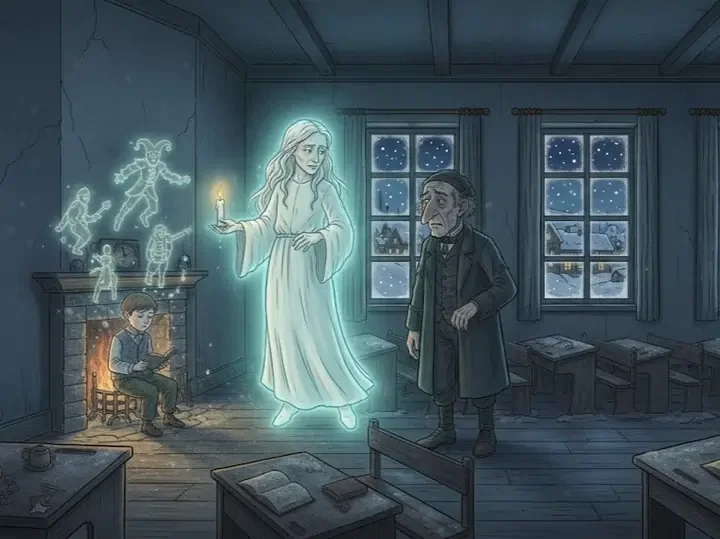
The Ghost took Scrooge by the arm, and in the next moment they soared through the air. They landed on a frost-covered field, near the old school where Scrooge had spent his childhood years. The school stood dark and empty in the snow.
"Do you know this place, Ebenezer?" the Ghost asked.
Scrooge sighed. He recognized every single stone in the building.
"I was a boy here," he whispered.
They went inside. The classrooms were quiet and cold. They saw Scrooge as a small boy, left alone at an old desk during the Christmas holidays. Loneliness hung heavy in the air. While the other children were home, he read alone and tried to forget that no one was coming for him.
"Poor child," Scrooge murmured, and for the first time his face showed a trace of sorrow.
The boy looked up from his book. Even though he was alone, he smiled. His mind wasn't empty; it was filled with imaginary friends. He saw Robinson Crusoe fighting pirates, and Ali Baba exploring treasures. He dreamed himself away from the cold and the heavy reality.
"Those friends were the only ones I had at Christmas," Scrooge said, and a warm tear fell.
Suddenly the empty school filled with light as a small figure ran into the room. It was his sister, Fan, far younger than himself but full of tremendous warmth. Her little face beamed with instant joy. She threw her arms around the lonely boy's neck.
"Dear brother! I've come to take you home!" she cried, her voice trembling with excitement. "Home for good, Ebenezer! Father has become so much kinder lately, and he said you never have to come back to this dreadful place again."
The young Scrooge, so used to cold and abandonment, could hardly believe it. This was a moment of pure, unexpected happiness. Fan wrapped him in a warm scarf and pulled him toward the door. They left the school as two joyful souls.
"She was always a ray of sunshine in my life," Scrooge whispered to the Ghost.
"She was the kindest person I have ever known. And she became mother to your nephew, Fred."
Again they soared through time and space. The Ghost stopped in a shop, filled with a warm glow of candlelight and infectious laughter. This was the office where Scrooge had worked as a young apprentice.
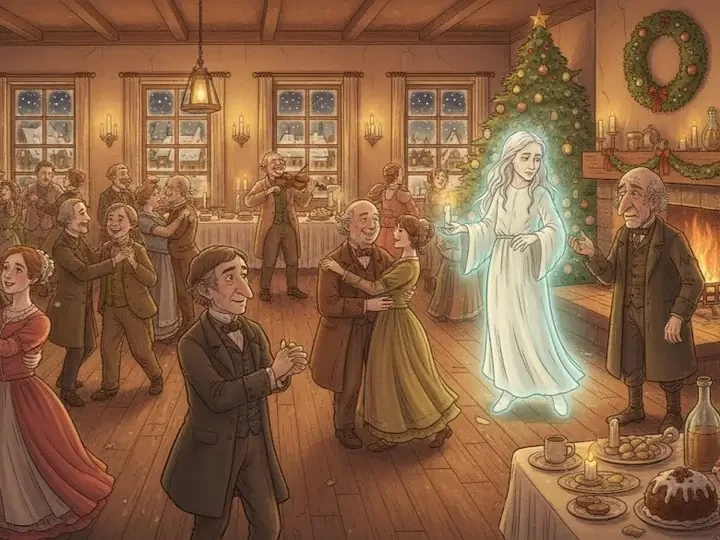
They saw the merry old man, Fezziwig, who owned the place. Just as the clock struck the evening of Christmas Eve, he clapped his hands.
"Come on, boys!" he called out in a bubbly voice. "Work is done for tonight! Let's celebrate Christmas!"
Instantly all the workers forgot their tiredness and the cold. Fezziwig and his wife transformed the office into a dazzling ballroom. There was music, dancing, and an abundance of food. Young Ebenezer Scrooge, along with his colleagues, danced and laughed with joy. It was a sight filled with true Christmas spirit.
Scrooge, standing beside the Ghost, began to smile.
"Fezziwig! How generous he was!" he murmured. "It was only a few coins he spent, but the joy he gave was enormous!"
The Ghost nodded.
"Yes, a master can spread happiness or misery with just a small word. What do you have to say about him, now that you are your own master?"
Scrooge fell silent. He thought of poor Bob Cratchit and the cold office. He felt a sharp, uncomfortable feeling in his chest.
The scene changed, and they now stood in a different, darker room. There sat a beautiful young woman, Belle, who was crying. Facing her stood a young Scrooge, but his eyes were already filled with greed and cold calculation.
"Our engagement is broken," Belle said in a voice full of deep sorrow. "You have changed. Another passion has replaced me in your heart; the pursuit of money."
The young Scrooge tried to defend himself, but his words rang hollow. He had found a new obsession: being rich.
"I am bound by promises I made when we were both poor," he said stiffly.
"I see a shadow of you before me," Belle replied. "You are afraid of the world, afraid of being poor, and your gold is now your only comfort. What woman could thrive in that shadow?"
She gave him back his freedom, the freedom to love his gold without hindrance. Scrooge watched the scene with tremendous pain. This was the real reason he was alone today.
The Ghost held up a small mirror.
"Look at yourself, Ebenezer. Look at the life you lost. Today you could have had a loving family by your side. But you chose the empty room you now sit in."
Scrooge's suffering was too great.
"Stop! Take me away from here!" he cried. "I can't bear to see any more!"
The sight of Belle and the life he'd lost became too much for Scrooge. Regret was a sharp knife in his heart. He couldn't bear the pain of watching himself throw away the greatest gift life had given him.
"Spirit, I beg you! Stop!" Scrooge cried desperately. He tried to cover his eyes to avoid seeing more of his past mistakes. "Why do you torment me? You're nothing but an instrument of torture!"
"I am only a carrier of the things that were," the Ghost answered in its gentle voice.
"Take me away! I can't bear this light any longer!" he cried, fighting against the radiant glow. He knew the light was showing him a truth he feared.
Scrooge lunged at the Ghost in an attempt to snuff out the flame on its head. The Ghost collapsed, and at once the bright glow went out. The room fell back into deep, black darkness.
Scrooge felt exhausted and collapsed onto the bed, weighed down by all the memories he had managed to recall.
Stave III: The Second Spirit – Christmas Present 🎄
Scrooge woke to a powerful roar and a new beam of light lighting up the room. He sat up, eager to meet his next visitor.
He didn't have to wait long. In the middle of the room stood a gigantic figure. It was the Ghost of Christmas Present. The Ghost was dressed in a green robe, lined with white fur, and wore a friendly, radiant smile. Around its head it wore a wreath of holly, and in its hand it held a torch shaped like a horn of plenty.
The Ghost sat on a throne made of food — piled with turkeys, geese, fruit, and cakes. A warm, hearty aroma filled the air.
"Look at me!" the Ghost called out in a loud, merry voice.
Scrooge, used to the cold, curled up in bed. He felt small before this blessing of joy and abundance.
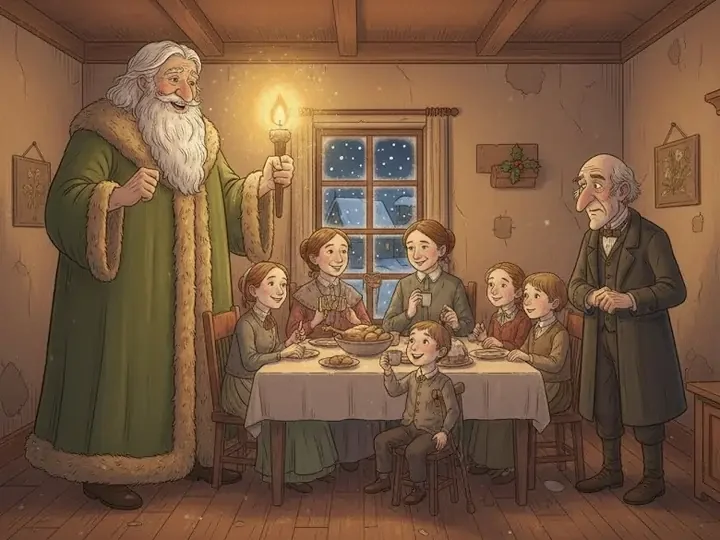
The Ghost took Scrooge with him. They traveled quickly to one of the city's poor neighborhoods. They soon stood inside a small but tidy room, belonging to his clerk, Bob Cratchit.
There was no abundance here, but there was delight in every corner. Mrs. Cratchit, dressed in a worn but neat dress, was helping her two eldest daughters set the table. The boys were noisy and full of anticipation. Despite the family's scant means, the air was filled with the smell of a modest goose and Christmas herbs.
In came Bob Cratchit. In his arms he carried his youngest son, Tiny Tim. Tiny Tim was a frail little boy with a crutch. He was so weak he could barely stand.
"Merry Christmas, my dear!" Bob said with a broad smile, setting the boy down by the fireplace.
As they sat around the table, Tiny Tim said quietly:
"God bless us, every one."
Scrooge looked at the boy with a feeling of new pain.
"How long will the boy live?" he asked the Ghost in a serious voice.
"I see an empty seat by his poor fireside," the Ghost answered with a sigh. "If the future remains unchanged, the child will die."
Bob Cratchit beamed with pride over his children. He loved them all dearly, but his greatest love shone toward Tiny Tim, who answered with a faint but warm smile. Scrooge felt a pang of guilt for having paid Bob so little.
Scrooge felt crushed by the Ghost's words. The sight of the frail boy, clinging to life, disturbed him deeply.
"If he is to die," Scrooge said in a hollow voice, "will he die quickly? Must he die?"
The Ghost looked at him with a reproachful glance.
"If you don't care about him, why do you ask? If the future matters so much to you, you may look to the workhouses you're so fond of. Or let those who are surplus just die and reduce the population!"
Scrooge recognized his own dreadful words, now thrown back in his face. The shame was overwhelming.
"No, no!" he stammered.
He felt a sharp pang of remorse. For the first time in many years, he was deeply concerned for another person's life. He pleaded with the Ghost to say that Tiny Tim would survive, and his hard heart began to show a small, tender sign of care.
The Ghost then took Scrooge on a walk through the city. Joy spread everywhere, even in the least welcoming places.
They saw people in the poorest homes sharing a small meal with warmth and laughter. They heard singing and music from every street corner. Everywhere there was a sign that Christmas was here, and that people chose to be happy. The Ghost sprinkled incense from his torch over the food they saw, to bless it and make it extra good.
Scrooge noticed that the joy was just as real and overflowing in the small, drafty houses as in the grander buildings. He saw sailors on ships, shepherds in the mountains, and miners deep underground — all celebrating the holiday with a smile and a sense of togetherness.
He began to understand that Christmas wasn't about money, but about love and sharing.
They moved on, and the Ghost took Scrooge to a bright and warm home. It was his nephew Fred's house. They were in the middle of a lively Christmas party, surrounded by games and loud laughter.
Fred raised his glass for a toast.
"Uncle Scrooge!" he said heartily. "I'm sorry he wouldn't come. His unfriendly mood mostly hurts himself. I'll drink to his happiness!"
The guests laughed, but Fred defended his uncle. He showed endless patience and love for Scrooge, even though he always got a harsh answer in return.
Scrooge, standing hidden beside the Ghost, began to listen to the happy voices and the warm music. He began to laugh along as they played a game. He felt an unusual and pleasant sense of belonging. This was an invitation to the life he had always refused.
He deeply regretted not having accepted Fred's sincere invitation.
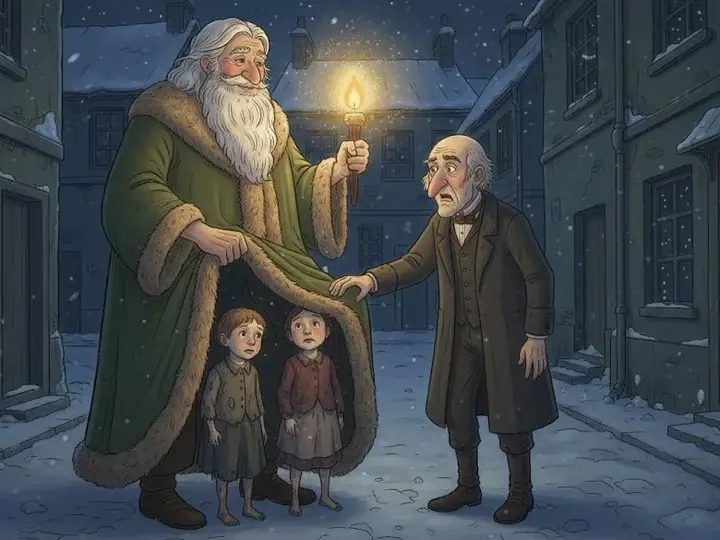
The evening drew to a close, and the Ghost of Christmas Present began to age rapidly. Before it vanished, it lifted its robe. Beneath the folds of the robe hid two frightening figures.
They were two small children, thin, ragged, and lifeless. The boy was named Ignorance, and the girl was named Want. They were pale and gaunt — a sight that cut Scrooge to the heart.
"Spirit, are they yours?" Scrooge asked, shaken.
"They belong to Mankind," the Ghost answered. "Look at their faces. Fear this boy most of all, for on his brow is written Doom."
The Ghost pointed toward Ignorance. Scrooge looked around anxiously.
"Do they have no help?"
"Are there no prisons? Are there no workhouses?" the Ghost replied, using Scrooge's own harsh words against him.
As he spoke, the clock struck twelve, and the Ghost of Christmas Present vanished. Scrooge stood alone once more, face to face with a massive shadow.
Stave IV: The Third Spirit – Christmas Yet to Come ⏳
As the last sound of the clock faded, Scrooge felt a massive presence standing in the room. He looked up and met the gaze of the third spirit. This one was the most frightening of them all.
The Ghost of Christmas Yet to Come was dressed in black from head to toe, wrapped in a heavy robe that hid both its face and its form. Only one outstretched hand emerged from the folds, silently pointing forward.
Scrooge trembled with fear. He knew this spirit was going to show him the shadows of things yet to happen.
"Are you the Ghost of Christmas Yet to Come?" Scrooge whispered, barely audible.
The Ghost didn't answer. It only pointed with its thin, dark finger toward the door.
"I fear you more than I've feared any other," Scrooge said. "But I know you have come to do me good. Lead me where you will."
The Ghost led Scrooge through the city streets to the Exchange. He saw a group of businessmen laughing and talking in low voices. They were discussing the death of a rich, greedy man.
"So he's dead, at last?" one of them said, almost indifferent.
"All I know is it'll be the cheapest funeral I've ever attended," said another. "Who's going to volunteer to go?"
They laughed at the deceased man's loneliness. Scrooge looked around. He recognized all the men, but he couldn't tell who the dead man was, since everyone seemed so uninterested.
He asked the Ghost to show him someone who was sad about the death, but the Ghost only shook its head slowly and pointed onward. It became clear to Scrooge that this man had lived a life without love or kindness.
He felt a nagging fear in his stomach.
"Spirit," he whispered, "this man's fate is brutal. This must not be my future."
The Ghost took Scrooge to a filthy, unfamiliar place. They stood outside a room where an old woman and two other figures, known to be thieves, were haggling over stolen belongings.
They had looted the dead man's house. They laughed as they sold off his precious belongings, including his bedsheets and even the shirt he was to be buried in.
"He hoarded everything while he was alive," the old woman said mockingly. "Now it's my turn to enjoy what he saved!"
Scrooge was filled with disgust. He couldn't believe that a man's belongings, even after death, could be treated with so little respect. There was no grief or reverence here, only greed and indifference.
"Spirit," Scrooge said with revulsion, "show me the room where this man lies, for I don't know this place!"
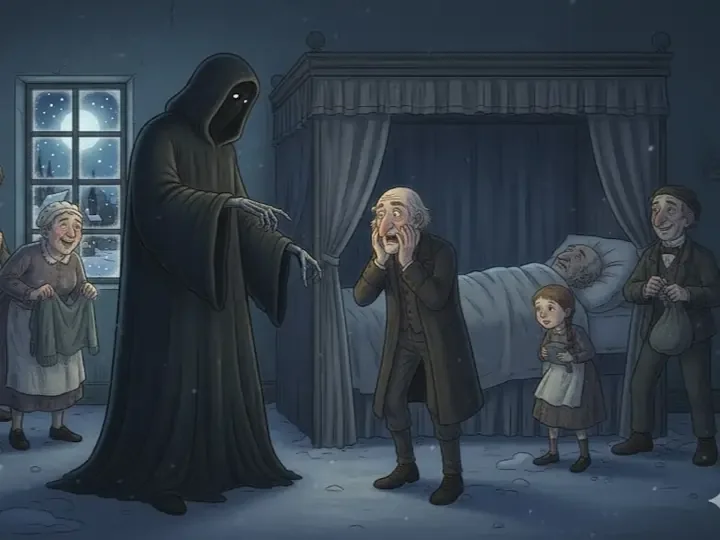
The Ghost led him back to Bob's home. Everything was quieter, darker. There was no cheerful laughter, only a heavy silence. Tiny Tim's little crutch stood alone in a corner, abandoned.
Bob Cratchit came into the room, his face marked with grief. He held his wife close as she wept quietly.
"He was so light to carry, my dear," Bob whispered, tears falling. "I can still see him before me. If only I'd had more money, maybe…"
Scrooge felt an intense, piercing pain. This was the result of his past indifference. Tiny Tim was dead because the future had not been changed.
"Spirit, this pain is almost too much to bear," Scrooge murmured.
Bob told his wife they had to be strong. He remembered Tiny Tim's words about how Christmas should remind them of the one who first made lame men walk and weak men strong. The Cratchit family was heartbroken, but united in their love.
Scrooge's heart ached. He knew this sight was more terrible than any thief or indifferent businessman. This was his own personal defeat.
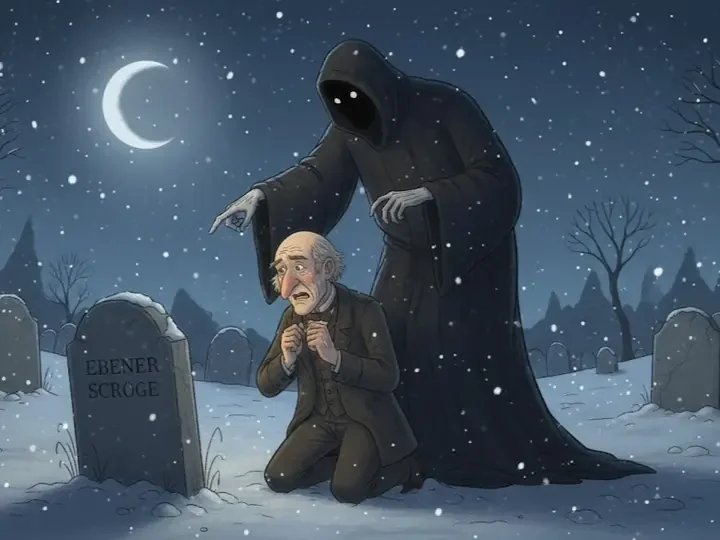
At last the silent Ghost led him to a cold, neglected graveyard. The dark figure stood still by a fresh grave, recently covered with earth. The Ghost pointed at the headstone.
Scrooge crawled forward, trembling, on his knees. He wiped the snow from the stone. There stood the name: EBENEZER SCROOGE. He was the lonely, indifferent man whose death no one mourned, and whose belongings were stolen.
"Spirit, is this my own grave I'm looking at?" he pleaded.
The Ghost nodded slowly.
"I am not the man I was! I promise to honor Christmas in my heart and try to keep it all year round! I will live in the Past, the Present, and the Future!"
He clung to the Ghost's robe.
"Oh, dear Spirit! Tell me I can change these shadows you've shown me! Give me a second chance!"
Scrooge collapsed in despair at the foot of the headstone.
"I don't want to die alone! I don't want this shadow to come true!" he cried, tears streaming down.
He raised a pleading hand toward the silent Ghost.
"I will honor Christmas, and I will remember every lesson! Tell me I can erase my name from that stone!"
As he grasped the Ghost's robe, it collapsed into nothing. Scrooge lost his balance and fell through the black darkness.
Stave V: Scrooge's Transformation and the New Christmas Morning ✨
Scrooge woke up in his own bed. He grabbed the bedsheets and laughed out loud.
"I'm here! The spirits have done it! There's still time for me!" he cried in a voice filled with pure joy.
The room was his own, familiar room. The windows were his own. This was such a great relief that he could hardly contain it. He began laughing and crying at the same time. "I've been given a second chance!" he rejoiced.
He leapt out of bed, light as a feather. He threw the heavy curtains aside and embraced them. The whole world felt new and radiant. He was full of tears and a childlike excitement. He felt young again, newborn.
He knew exactly what he had to do to honor his promise to the Spirits.
Scrooge got dressed quickly. He opened the window and called out to a young boy walking down the street.
"Do you know what day it is today?" Scrooge asked with a beaming smile.
"Christmas!" the boy answered, astonished by the man's infectious joy.
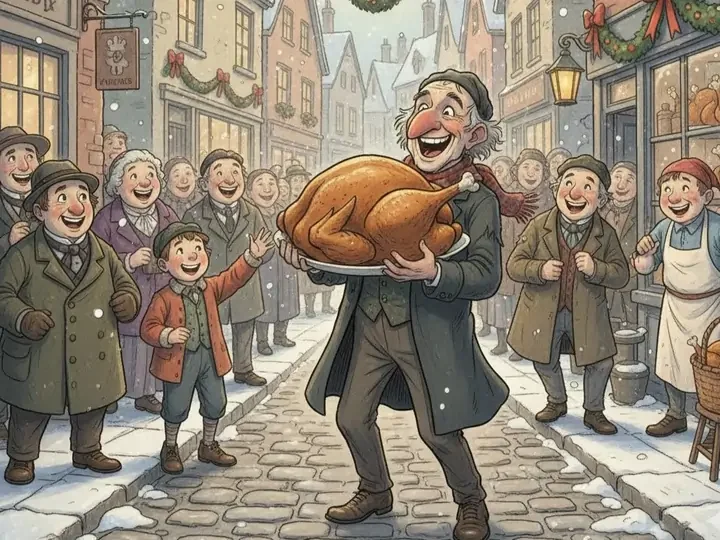
"Wonderful!" Scrooge cried. "Go and buy the biggest turkey in the shop — the one that's simply enormous!"
The boy ran off at full speed. Scrooge laughed heartily and gave the young boy plenty of money, plus a generous reward. The turkey was to be sent anonymously to Bob Cratchit's house. It was so big it would hardly fit in their home.
Scrooge's heart trembled with joy and anticipation. This was an overwhelming feeling of happiness he had never known before. He had never before felt the joy of giving.
Scrooge left the house. He walked out onto the street with a light heart and a broad smile. He greeted everyone he met with a warm "Merry Christmas!"
People in the street stopped and stared. They were so used to his sour, stern face that they could hardly believe their own eyes. Was this really Ebenezer Scrooge?
He soon met one of the charitable gentlemen who had asked for money the day before. Scrooge stopped him and pressed a large bag of coins into his hand.
"Please, my friend," Scrooge said. "Accept this, and I owe you a thousand apologies for my rude behavior yesterday. Please, help support the poor!"
The man was so shocked he could barely speak, but Scrooge hurried on, beaming with joy.
Scrooge went straight to his nephew's door and knocked before he could change his mind. He stood there, as nervous as a child. Fred opened the door and froze in surprise when he saw his uncle.
"Fred, my dear boy!" Scrooge cried.
"Uncle Scrooge?" Fred answered, in disbelief.
"Yes! It's me! Can you forgive a fool for his past foolishness? I've come to have dinner with you and your wife today. Will you let me in?"
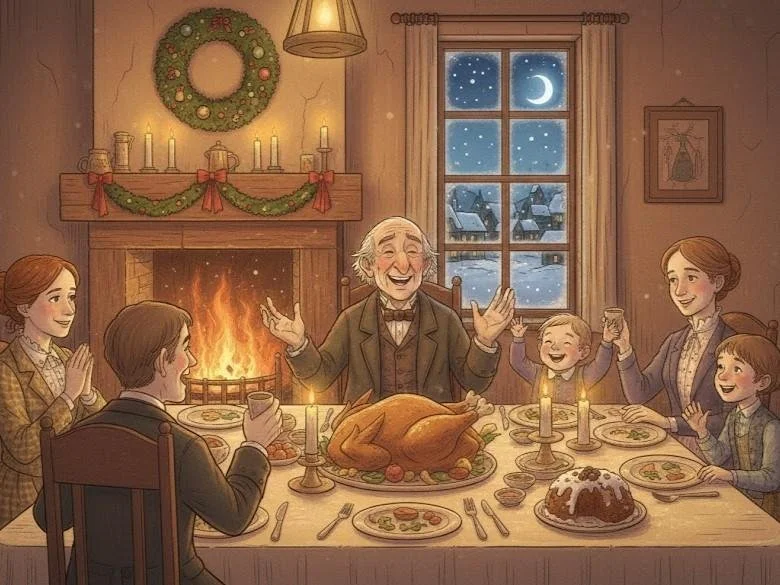
Fred's face broke into a broad, warm smile. Without another word he pulled his uncle in from the cold. Scrooge was welcomed with true love and respect. He had finally found his place in the family.
Scrooge waited eagerly at the office the next morning. When Bob Cratchit arrived late, Scrooge first pretended to be furious, just to build the suspense.
"Get in here, sir! What's the meaning of this?" Scrooge roared.
Bob trembled with fear, ready to be scolded. But Scrooge beamed and said:
"I'm giving you a raise, Bob, and I'm going to help your dear family!"
Scrooge kept his word. He became a wonderful boss and a second father to Tiny Tim, who received better care and did not die. Happier Christmas days never came to the Cratchit family.
From that day on, Scrooge understood how to honor Christmas in his heart every single day. He lived by the knowledge the three Spirits had given him.
He quickly became as good a master and as good a friend as London had ever known. It was said of him that he knew how to celebrate the holiday better than anyone. And Tiny Tim, who was now strong, always said: "God bless us, every one!"
THE END
A Christmas Carol: Background, Meaning, and Legacy
The story behind the classic
When Charles Dickens published A Christmas Carol in 1843, his goal was to create a story that could stir both warmth and reflection in a time marked by great social inequality. England was in the midst of the harsh realities of industrialization: poverty, child labor, and a lack of empathy. Dickens wanted to write a work that could move the heart while also shining a light on the need for compassion and responsibility.
"I have endeavored to raise an idea that might bring joy and goodness to more homes." – Charles Dickens
The author's own background — with financial troubles, child labor, and firsthand experience of London's darker corners — makes the message especially powerful. Many of his best-known works, including A Christmas Carol, spring from a desire for social justice, warmth, and human dignity.
Why the story still matters so much
Even nearly two hundred years after it was written, the story remains just as relevant. The themes Dickens raises are universal:
- transformation
- empathy
- responsibility
- community
- the true spirit of Christmas
The story reminds us that Christmas isn't about gifts or luxury, but about seeing others, showing care, and sharing what we have. Through the journey with the three spirits, Scrooge — and the reader — learns that it's never too late to change.
The timeline itself is symbolic: Past → what shaped us. Present → who we are now. Future → what we can become.
Dickens' story is often used in schools, families, and Christmas traditions because it delivers a clear moral in a warm and easy-to-understand way.
Key characters and their roles
The story is rich with memorable figures, each carrying their own meaning:
- Ebenezer Scrooge: A strict, miserly, and lonely man who undergoes a profound personal transformation.
- Jacob Marley: Scrooge's former business partner, chained in the afterlife as a result of his cold and selfish life.
- The Ghost of Christmas Past: A glowing being who shows Scrooge what he has lost and the choices that shaped him.
- The Ghost of Christmas Present: A lively, warm figure who shows how others celebrate Christmas — with both joy and hardship.
- The Ghost of Christmas Yet to Come: A silent, dark figure who reveals the consequences of Scrooge's actions if he doesn't change.
- Bob Cratchit: The loyal and hardworking clerk who represents kindness, gratitude, and family values.
- Tiny Tim: A powerful symbol of innocence, hope, and vulnerability — and a turning point for Scrooge's heart.
These characters carry the story and make its moral message clear and moving.
A Christmas Carol: A Holiday Classic in Popular Culture
A Christmas Carol has had an enormous influence on modern Christmas traditions. Since 1901, the story has been filmed, dramatized, and adapted countless times. Everything from Disney versions to stage productions and modern film releases has kept the story alive for new generations around the world.
Several historians actually believe Dickens helped shape the whole of modern Christmas celebration, in part by highlighting:
- kindness toward others
- care for the poor
- the joy of being together
- warmth and community as core values
The fact that the story keeps being retold shows how deeply it resonates with both children and adults.
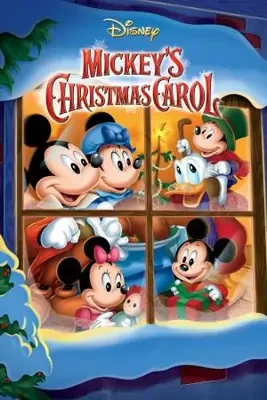
Mickey's Christmas Carol (1983)
Disney's 1983 version is one of the most iconic adaptations of Dickens' work. In it, Mickey Mouse, Donald Duck, and Goofy take on the classic roles, making the story accessible to children around the world.
The adaptation isn't a scene-for-scene retelling, but it preserves the story's core message: compassion, warmth, and the power of personal transformation. The Disney version compresses the plot and gives it a lighthearted touch to make the story less frightening for younger viewers.
That made the film groundbreaking in its time: for millions of children, this was their first encounter with Scrooge, Tiny Tim, and the Christmas spirits. That's why it's considered one of the most culturally influential versions of A Christmas Carol.
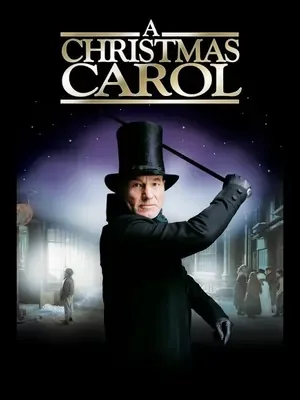
The Classic 1999 Film
The 1999 film adaptation is known as one of the most faithful and atmospheric renderings of Dickens' original. Patrick Stewart delivers a powerful and convincing portrayal of Ebenezer Scrooge, and the film closely follows the structure of the five "staves."
This version is especially appreciated for its measured pace and its classic British tone, which gives the experience a timeless quality. It has become one of the most widely used films in both holiday traditions and classrooms because it's serious, accessible, and very close to Dickens' original vision.
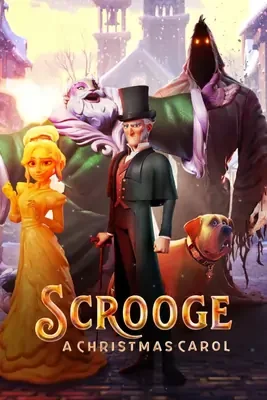
"Scrooge: A Christmas Carol" (2022, Netflix)
The most recent major film adaptation arrived in 2022. The Netflix version is a musical with modern CGI animation, and it attempts to modernize Dickens' classic without losing its core.
The film keeps the main scenes — Marley's warning, the memories of Christmas past, the warmth of the Cratchit family, and the grim vision of the future — but adds new musical numbers and visual elements that give the story a more modern feel.
Among today's young viewers, this version is considered one of the most accessible and engaging, precisely because the music, color, and pacing bring the classic to life for a new generation.
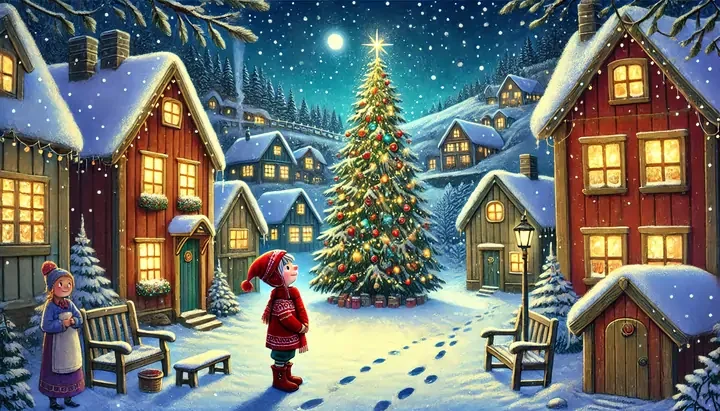
Stargate: A Christmas Tale (Ingvild H. Rishøi, 2021)
Although Stargate: A Christmas Tale isn't a Dickens adaptation, it's one of the most sought-after works in Norwegian Christmas literature, often searched for alongside Dickens' classic simply because of the shared "Christmas tale" title.
Rishøi's story has won great critical acclaim for its raw, realistic, and deeply human portrayal of a family's struggle during the Christmas season. It blends a modern, tender setting with classic Christmas motifs, and shows how hope and care can exist even under difficult circumstances.
Many consider it a "new Norwegian Christmas classic," and it's often mentioned alongside A Christmas Carol because both works are about family, Christmas, hope, and change, though in very different ways.
Other well-known interpretations and modern works (a brief overview)
Several other works and interpretations often come up in connection with Dickens, and while they aren't direct adaptations, they've helped shape the Nordic Christmas storytelling tradition. Here are the most relevant:
- Lisa Aisato. Aisato's illustrated Christmas stories have made her one of Norway's most beloved children's book creators. Her work shares thematic roots with Dickens: warmth, hope, and human connection.
- Erlend Loe. Loe's humorous and warm writing style makes him popular during the holidays. Though he doesn't write Dickens adaptations, many readers seek out his Christmas writing in the same spirit.
- Christmas tales on streaming platforms. Searches for Christmas stories online turn up several streaming versions that have come and gone over time, including older animated films and modern musicals.
It's also worth a brief mention that "Stargate: A Christmas Tale" often comes up in searches alongside Dickens' classic, but the book is an entirely different, modern Norwegian novel — not an adaptation of A Christmas Carol. Even so, it's a powerful and moving story we're happy to recommend as a reading tip here on FabelTales.com.
These works aren't directly connected to Dickens, but they show how broadly the idea of a "Christmas tale" is used in modern culture — from classic adaptations to new Norwegian voices.
What children can learn from the story
A Christmas Carol isn't just an exciting Christmas tale — it's also a story filled with valuable lessons for young readers:
- caring about others
- sharing what you have
- appreciating family
- understanding that everyone can make mistakes — and make them right
- how small acts of kindness can have a big impact
- how empathy makes us stronger as people
Scrooge's journey from cold to warmth makes the moral easy to understand and inspiring to follow.

Frequently Asked Questions (FAQ)
— Is "A Christmas Carol" suitable for children? Yes. In an adapted version — like this one — it's perfect for reading aloud during the holiday season.
— How long is the original story? It's fairly substantial, but our version has been carefully shortened to suit children and young readers.
— Who is the main character? Ebenezer Scrooge, a man who discovers what the true spirit of Christmas means.
— What's the main message? That kindness, empathy, and togetherness can transform both ourselves and the people around us.
More Christmas stories for children
If you enjoyed A Christmas Carol, you'll find more warm, atmospheric, and exciting Christmas stories here on the site. Perfect for the holiday season, cozy evenings, and reading together as a family.
 English
 Norsk
Norsk Svenska
 Dansk
Dansk Deutsch
 Nederlands