


Bambi learns about nature, loses his mother, and grows at last into the forest's next protector.
Bambi is a tale by Felix Salten from the early 1900s that follows the life of a roe deer in the forest. This retelling stays close to Salten's classic novel: a warm, at times stern account of curiosity, loss, and responsibility, told with closeness to nature. The story below follows Bambi from his first spring until he emerges as a young, maturing stag — faithful to the tone and events of the original.
The Tale of Bambi — a Coming-of-Age Story from the Forest 🦌
🐾 Birth and the First Days of Spring
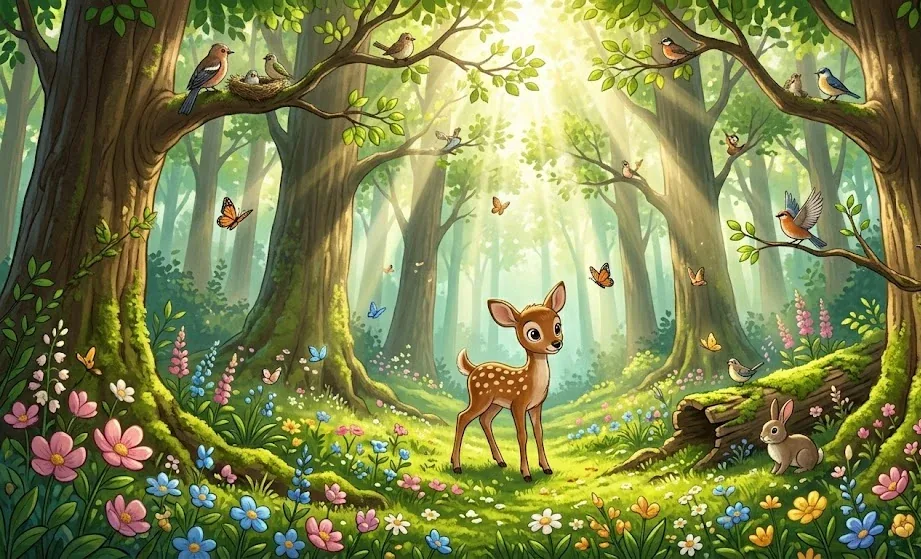
He was small and frail the first morning he opened his eyes to the world. His coat was dappled like little patches of sunlight on the ground. His mother kept him close by her side, her gaze watchful and calm. Around them the forest was awake: birds chirped, the grass smelled of spring, and the air carried a cold, fresh edge.
Bambi thrived at his mother's side. He wanted to leap, to play, to taste snail shells and leaves. But more than anything, he wanted to understand what everything around him meant. His mother showed him which paths were safe by day, where to find food, and how the wind could warn of danger. She spoke low and firm, as though handing him pieces of a secret map to life in the forest.
Stay close to me, Bambi.
said his mother, and her voice was both gentle and sharp. Bambi pressed close to her and learned, without words, to follow her steps, to watch where she listened, and to sense when she stiffened with alertness.
They met other animals: sparrows that sang, squirrels that spun from branch to branch, and the first time they stopped by a pool of water, Bambi grew used to his own reflection in the still surface. He learned to run, to dodge the fallen branches that lay across the path, and to bend down and pluck green shoots. Every small skill was a piece of his growing world.
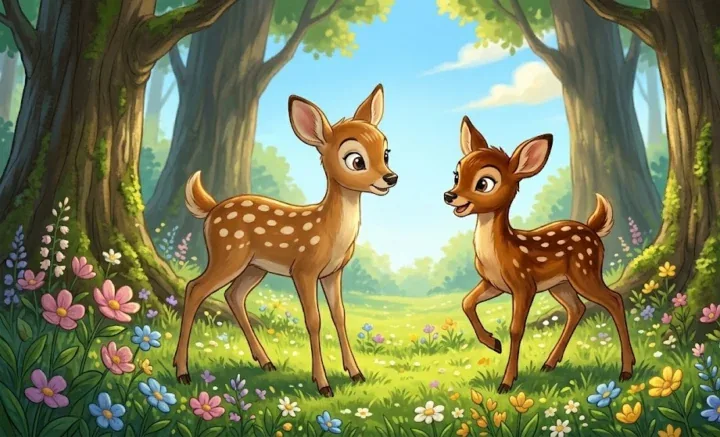
One day, as the light hung low toward evening, another young one came toward them — a little doe with a lively crinkle in her nose. She moved with playful steps and curious eyes. Her name was Faline.
🌲 The Loss of His Mother and a New Fear
As the months passed, Bambi learned what "danger" could mean. His mother's guidance had sheltered him, but not enough to keep the sounds of man entirely away. The shots came like an unfamiliar, deep rumble, rare at first, then growing stronger. One day the sound changed everything.
The forest was silent. Bambi and his mother stood hidden among roots and old branches. His mother tensed; she caught a new scent on the wind and pressed him lower against her. Then a shot rang out, and a moment later the world had changed.
Stay in the shadows. Don't stray far from me.
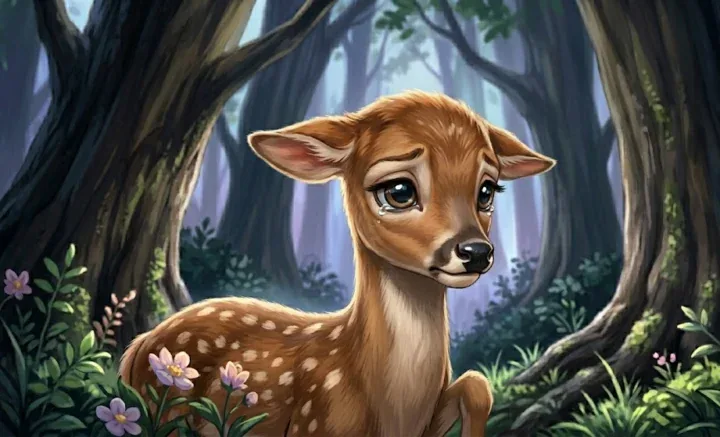
whispered his mother, just as she had done so many times before. But this time Bambi came back alone to the place where his mother had once stood. The emptiness sat large and heavy in his chest. He didn't fully understand what had happened, but he felt the void she had left behind — a steady, guiding presence, gone.
After the loss, Bambi became more alert to sounds and smells. He quickly learned that humans were something that came from outside, something that didn't follow the forest's rules. Some nights he could hear the distant echo of footsteps and dogs. He never slept entirely without keeping half a watch, the way a young animal does once the world has suddenly grown sharp edges.
❄️ Learning from the Great Stag and the Trials of Winter
As time passed, he came to know a mighty stag whom everyone regarded with awe. They called him the Great Stag. No one ever said aloud who he truly was to Bambi, but something in his gaze felt familiar — he was the forest's authority: large, solemn, and watchful. From him Bambi learned what strength meant, how to leave tracks in the snow, and how a stag understood the forest's order.
The Great Stag spoke rarely, but when he did, it sounded like the wind through the tall pines. He showed Bambi how to keep eyes and ears open, how to judge when it was safest to graze and when to stand perfectly still, a part of the shadows. Bambi watched him with a mixture of fear and admiration, and began to dream of one day moving with that same calm and strength.
The winters were long and cold. Food was scarce, and the nights were full of sounds that could be hungry predators or simply the wind breaking over the pine tops. Bambi learned that cold made the world less playful, but stronger. He grew in body and in caution. He felt that, slowly but surely, he was changing from a playful fawn into a deer who could stand watch.
❤️ Love, Play, and Rivals
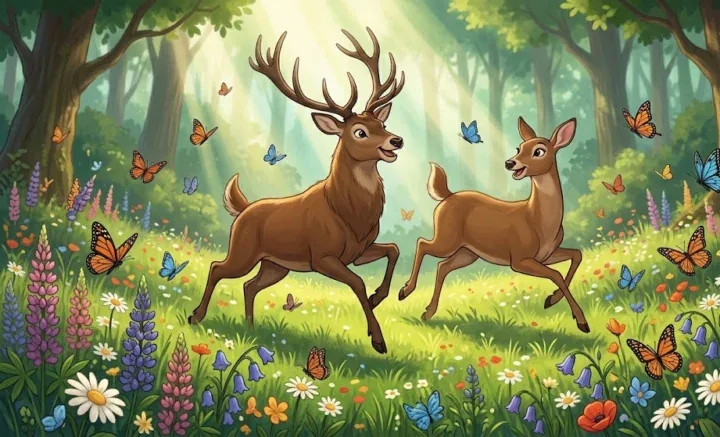
The summers returned with warmth and fresh greenery. Faline was still by his side; they played, sparred playfully, and learned each other's limits. The affection that grew between them wasn't only a wish to be near one another — it was also a lesson in how to show courage without being needlessly reckless.
Come on, run with me!
Faline called out once, and Bambi answered with a bound. They chased each other across a clearing, the sun tracing the shadows of their leaps. Other deer came and went. Some were prouder, with heavier antlers; others were young and bold like him. One of them tried to show himself greater than Bambi, and a brief clash broke out over Faline's attention.
Bambi noticed that it was no longer enough to run fast — he had to prove himself worthy too. He learned to stand firm, to use his gaze and his bearing. These small trials against rivals shaped him, and slowly Faline drew closer to him, because she sensed he was the one ready to guard and lead when the time called for it.
🗝️ The Encounter with Man and the Responsibility That Follows
Over time, the dangers of man became more than just the occasional shot. Hunters and dogs drew closer, and the whole forest felt the new unease. Bambi stood beside the Great Stag when the warnings passed through: the scent of humans, the echo of dogs in the night, and escape routes used by several animals at once.
One autumn day the forest grew restless. The barking of dogs broke over the valley, and the herds scattered in panic. Bambi ran without quite knowing why, but instinct and the Great Stag's teaching kept him moving. In the middle of the chaos he felt a blow, a sting that made him limp. The pain was sharp, but not fatal. He fell, but rose again, because the forest didn't ask him to give up — it demanded that he go on.
Hold on. Find shelter, and wait until it's safe.
said the Great Stag, as he limped past with a solemn look. Bambi remembered the words. He found a dense thicket and lay still while the dogs and the humans went on with the chase. When the silence came, he was breathing hard, but he was alive. The wound healed slowly; every day he grew stronger.
When the dangers had passed, Bambi found himself in a different place in the forest — wiser, tougher. He was no longer just a part of play and fun. He began to feel responsibility: for Faline, for the paths they shared, for the younger animals who looked up to the grown ones. He also came to understand how the Great Stag carried the burden of protecting the whole forest.
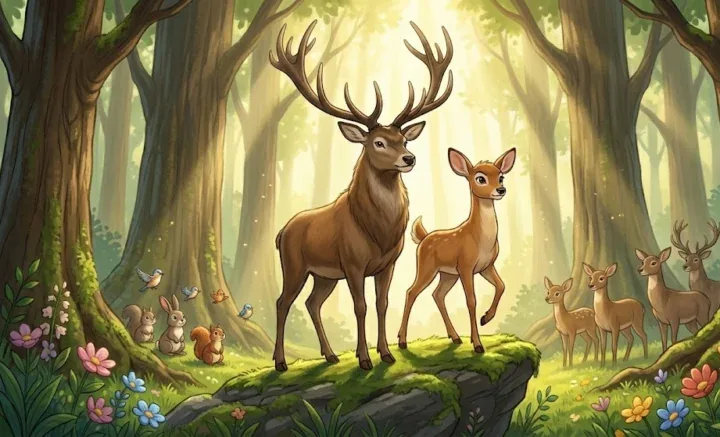
At last, after many years of trials, the day came when the Great Stag could no longer roam the high ground as before. Then, and only then, did Bambi understand the truth he had long sensed: the Great Stag was his own father. Bambi stood by his side, carrying the memory of everything he had learned. As the Great Stag slowly withdrew, Bambi stepped forward — not as an eager young deer, but as his father's heir, one who had learned to carry the forest's voice onward.
The Moral of Bambi 💛
Bambi teaches us that growing up means caring for others and understanding danger. Loss can make the heart heavy, but it also teaches us to become careful, caring, and brave in new ways. The forest in this story reminds us that responsibility and strength often grow out of grief and practice, and that humankind can be both beautiful and dangerous to nature's rhythm.
Questions for the Reader
- What did Bambi learn from his mother in the first months?
- How did life change for Bambi after the shot that took his mother?
- Which qualities of the Great Stag helped Bambi become more responsible?
- Why was the encounter with humans such a great trial for the animals of the forest?
- How does Bambi show care for Faline and the younger animals as he grows older?
- Which moment in the story did you find most dramatic, and why?

Did You Know This About Bambi? 🧐
- The book "Bambi, a Life in the Woods" (Bambi. Eine Lebensgeschichte aus dem Walde) was written by Felix Salten and published in 1923 in Austria.
- Salten's novel portrays a roe deer's entire life — birth, loss, love, and responsibility — and differs from later film adaptations by being more realistic and, at times, darker in tone.
- The name Faline comes from the original novel; she is an important figure in Bambi's life, not an invention of modern animation.
- In the novel, humans are often portrayed as a shadowy, incomprehensible threat; Salten used this to show nature's own logic and the boundaries animals must live within.
- The book has been translated into many languages and discussed as both nature poetry and an adult parable, but it is also read by older children (a recommended age of roughly 8–12 for adapted read-alouds or abridged versions).



 English
 Norsk
Norsk Svenska
 Dansk
Dansk Deutsch
 Nederlands