

A little duckling is seen as different from his siblings from the moment he's born -- until the day he discovers what he truly is.
The tale of the Ugly Duckling is one of the best-known fairy tales written by H.C. Andersen. In this classic story, we follow a little duckling who, from the very beginning, is seen as different from the others.
The story tells of how it can feel not to fit in, and how hardship, patience, and time can lead to a surprising transformation. Through a simple but moving tale, Andersen shows how something that at first seems weak or unusual can turn out to be something truly special.
Now let's read the story of the Ugly Duckling — a tale of hope, growth, and finding your own place in the world.
The Ugly Duckling — Read the Fairytale
An egg that's different
Summer had come to the land, and out on the old farm a mother duck lay in her nest, rocking her eggs. Around her the grass grew tall, and a warm sun shone over the meadow. She had been waiting a long time now, and was starting to grow a little impatient.
Suddenly there was a small crack.
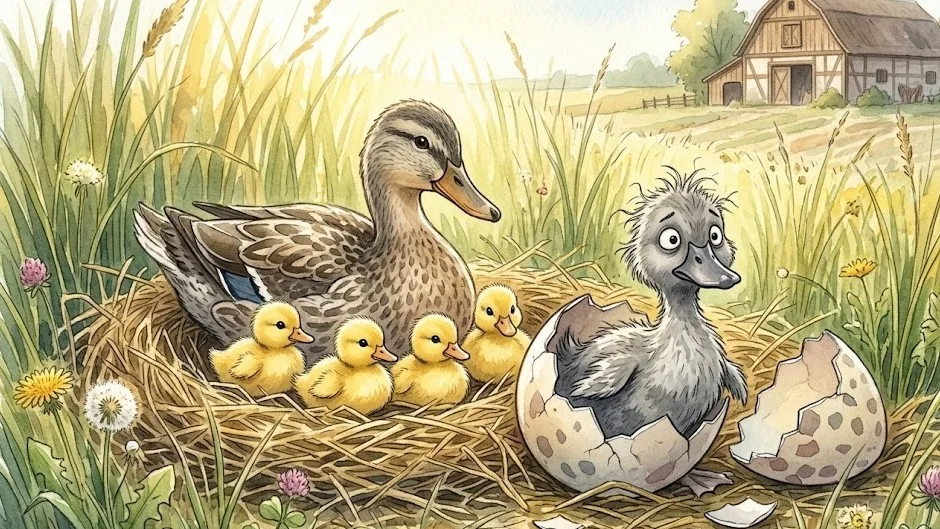
One of the eggs split open, and a little yellow duckling poked out its head. Soon more eggs cracked, and small ducklings came into the world one after another. They shook out their soft down and looked around curiously.
The mother duck smiled, pleased.
"Look how fine you all are," she said gently. "And how big the world must seem to you now."
But in the middle of the nest, one egg still remained.
It was bigger than the others, and it had lain there a long time without stirring. The mother duck turned it carefully with her beak and gave a little sigh.
"This egg will never hatch, I think," she murmured. "But I suppose I'll have to be patient a little longer."
At last, after a long wait, the big egg too began to crack. The shell opened slowly, and out came a duckling that looked quite different from the others.
He was bigger, his feathers were gray and a little ruffled, and he seemed clumsy as he tried to get up on his feet.
The mother duck studied him closely.
"You look a bit strange," she said thoughtfully. "But I suppose you'll learn to swim like the others."
The duckling is mocked
The next day, the mother duck took all the little ducklings down to the pond. They waddled after her through the grass, a little unsteady on their feet, but curious about everything they saw.
"Be sure to stay close to me," said the mother duck. "Now you're going to learn to swim."
She glided calmly out into the water, and one by one the little ducklings hopped in after her. To her delight, they immediately began paddling with their little feet.
"Look at that!" she said proudly. "You're all swimming. It's in your blood."
Even the big, gray duckling swam just fine. The water held him up as easily as it did the others.
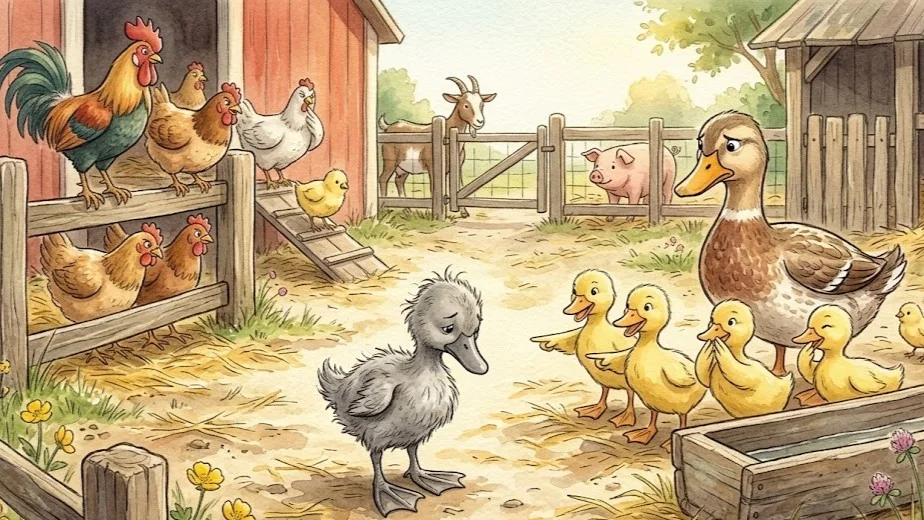
Afterward they went up to the farmyard to greet the other animals. There were hens clucking, a cat lying in the sun, and several grown ducks waddling about.
But the moment they saw the gray duckling, they began to stare.
"Look at that one!" one of the ducks called out. "How ugly he is!"
A hen laughed loudly.
"He doesn't even look like a proper duckling at all."
The other ducklings were influenced too, and began to pull away from the gray one.
The poor duckling tried to hide behind his mother, but everywhere he went, he was met with laughter and sharp looks.
"Couldn't he look a little nicer?" said an old duck sourly.
The mother duck shook her head.
"He swims well," she answered firmly. "And that's what matters most."
But the little duckling already felt different.
The little duckling flees the farm
The days passed, but life on the farm didn't get any easier for the gray duckling. The other animals kept laughing at him, and even his siblings began to turn away.
"I wish you weren't our brother," whispered one of the little ducklings one day.
The poor duckling didn't know what to do. Everywhere he went, he was shoved, teased, or chased off.
In the farmyard, the hens pecked at him. The ducks turned their backs on him. Even the cat looked at him with a cold stare.
One day, it became too much.
As the sun began to set behind the trees, the duckling slipped quietly away from the farm. He ran as fast as his long legs could carry him, through tall grass and over narrow paths.
At last he came to a big reed bed by a pond he had never seen before.
There he hid among the reeds and tried to catch his breath.
"I just want to be somewhere no one laughs at me," he whispered sadly.
In the pond swam some wild ducks. They looked curiously at the strange bird that had suddenly appeared.
"Who are you?" one of them asked.
The duckling lowered his head.
"I'm not really sure," he answered quietly.
The wild ducks didn't much care how he looked, and for the first time in a long while, the duckling was left in peace. But he still felt alone in the big world.
A long journey through summer and fall
The gray duckling stayed a while in the reeds by the pond. The wild ducks left him in peace, and the days went by more calmly than before. Still, he never quite felt at home. He knew he was only a stranger who had ended up there by chance.
One morning, two young wild ducks came swimming over to him.
"You look a bit strange," said one of them, "but that doesn't matter to us. If you like, you can stay here with us."
The duckling didn't know what to say. Before he could answer, loud bangs suddenly echoed through the air. Bare trees and reeds shook, and the birds on the pond flew up in a panic.
"Hunters!" one of the ducks cried.
Gunshots echoed across the marsh, and the duckling threw himself down into the grass in fright. He lay perfectly still while dogs ran through the reeds, searching for birds.
A great hunting rifle fired again, and the duckling trembled with fear.
After a while, everything went quiet. The birds that remained had fled far away. The duckling barely dared to lift his head.
"I have to get away from here," he whispered.
He left the pond and began wandering on through the landscape. The days passed, and summer slowly turned to fall. The wind grew colder, the leaves on the trees turned yellow and red, and the nights grew longer.
One evening the duckling looked up at the sky.
There flew a flock of large, beautiful birds with long necks and broad wings. They moved through the air quietly and gracefully.
The duckling felt a strange feeling in his chest.
"Oh, how beautiful they are," he said softly, following them with his eyes until they disappeared into the distance.
The cold, hard winter
Soon winter came.
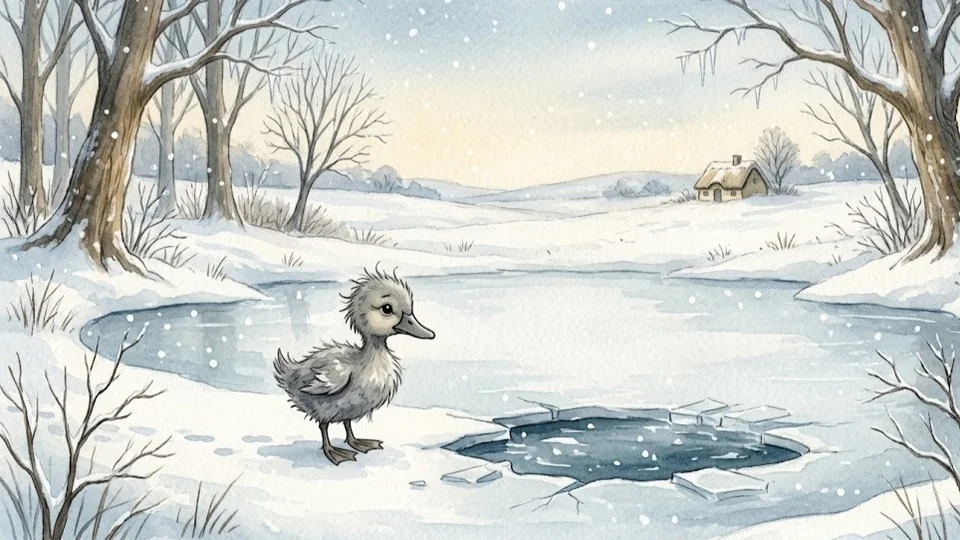
The wind turned icy, and snow began to cover the fields and forests. Ponds and small streams froze over, and it grew harder and harder to find food.
The little duckling had to keep swimming all the time to keep a small opening in the ice free. Every day the hole grew smaller, and the cold sank deeper into his body.
"I just have to keep moving," he told himself. "Or I'll freeze in place."
But at last he grew so tired that he could barely move his wings. One night the ice closed in completely around him, and the duckling was trapped.
Early the next morning, a farmer passed by the pond. He caught sight of the poor bird frozen fast in the ice.
"Poor little thing," said the man, and broke the ice open with his boot.
He took the duckling home with him to his farm. It was warm there, and the children in the house grew curious when they saw the strange bird.
"Look!" one of the children shouted. "A duckling!"
They tried to play with him, but the poor bird was frightened by all the attention. He flapped wildly around the room, knocked over a milk pail, and startled the cat lying by the fireplace.
The children began to laugh, and in the confusion the duckling found an open door.
He hurried back out into the snow and hid among some bushes. There he stayed, quiet, for the rest of the winter, lonely and exhausted, waiting for the day the cold would finally end.
Meeting the beautiful swans
At last winter began to loosen its grip. The snow melted slowly, and small streams began to trickle between the trees again. The air grew milder, and the sun warmed a little more with each passing day.
The weary duckling crept carefully out from his hiding place. He had grown a great deal over the winter, and his wings had grown stronger.
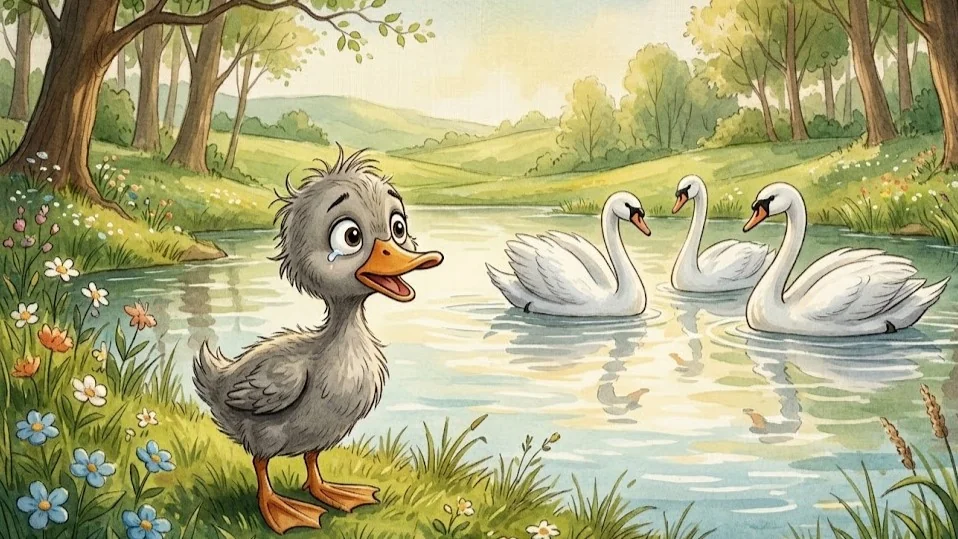
One day he went down to a large pond that lay still between green meadows. There swam some large, white birds with long necks and graceful movements.
The duckling recognized them at once. They were the same beautiful birds he had seen flying across the sky in the fall.
He stood completely still, watching them.
"How beautiful they are," he said quietly to himself.
He suddenly felt very small and sad again. At the same time, he felt a strong longing to come closer.
"I know they'll probably chase me away," he whispered. "But it doesn't matter. It's better to be chased off by birds as beautiful as these than by ducks and hens."
With a pounding heart, he went down to the water and swam slowly toward the swans.
The great birds noticed the stranger and glided calmly closer. The duckling bowed his head and waited for them to peck at him.
But instead, they looked at him with calm eyes and swam quietly around him, as if he were one of them.
The great transformation
The young bird stood still in the water while the beautiful swans swam calmly around him. He barely dared to lift his head.
"Now they'll surely chase me away," he thought.
Carefully, he bent his neck down toward the surface of the water. There, in the clear water, he suddenly saw his own reflection.
But it was no longer a gray, clumsy duckling looking back.
Instead he saw a large, white bird with long wings and an elegant neck. His feathers had become clean and gleaming, and his movements in the water were calm and proud.
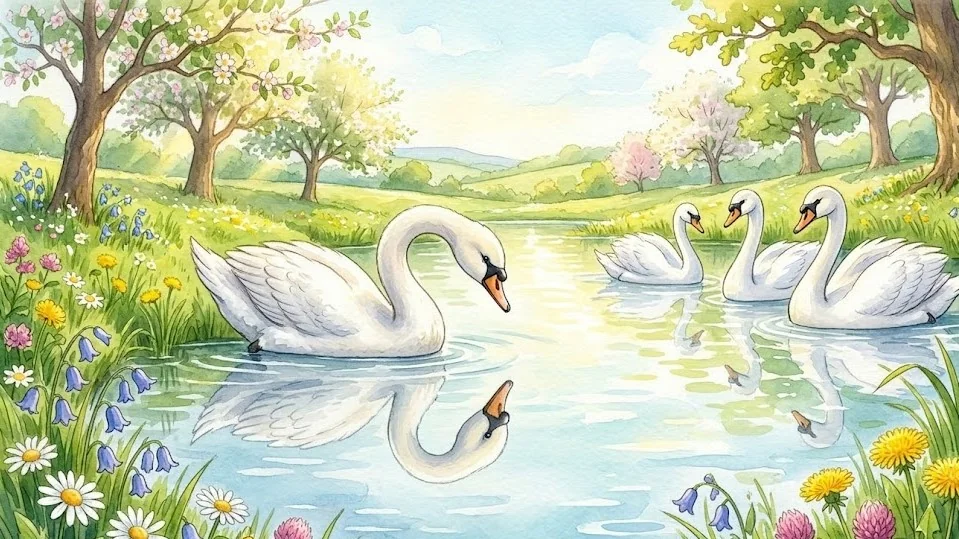
He lifted his head in surprise.
"Is… is that really me?" he whispered.
The other swans came closer and greeted him warmly. They swam together across the pond, as if he had always been part of the flock.
Just then, some children came walking along the bank of the pond. They stopped when they caught sight of the swans.
"Look!" one of the children shouted. "There's a new swan!"
"He's the most beautiful of them all," said another child.
The young swan felt a warm feeling in his chest. He remembered all the days when he had been teased and chased away, and had hardly dared believe he could ever belong anywhere.
Now he glided calmly through the water together with the other swans, while the sun shone over the pond and spring filled the air around them.
THE END

The moral of the Ugly Duckling
The moral of the Ugly Duckling is simple and beautiful: sometimes we may feel different or left out, but that doesn't mean we don't belong. In the story of the Ugly Duckling, we learn that everyone grows at their own pace, and that what seems weak or strange at first can become something truly wonderful.
What do you think about the story?
🤔 How do you think the little duckling felt when the others laughed at him?
🦢 What did you think when he discovered he was really a swan?
💭 Have you ever felt a little different, the way the duckling did in this story?
Feel free to talk about the story together — sometimes a good story about the Ugly Duckling becomes even better when we share our thoughts.
Background and meaning of the Ugly Duckling
The story of the Ugly Duckling was written by the Danish fairy-tale author Hans Christian Andersen and published in 1843. The tale quickly became one of the best-known in European children's literature, and today it has been translated into many languages and read by children all over the world.
Many literary scholars believe the Ugly Duckling may also hold personal meaning for its author. As a child, Andersen often felt different and left out, and he faced a great deal of hardship before finally becoming one of the world's most celebrated storytellers. For this reason, the tale is often read as a story about growing up, finding your place, and discovering who you truly are.
Over the years, the story has been retold in many forms. It appears in children's books, illustrated fairy-tale collections, and school books. It has also inspired films and cartoons, including the well-known animated film The Ugly Duckling from The Walt Disney Company.
But the reason the story of the Ugly Duckling remains so popular is simple: it's about something almost every child can recognize in themselves. The feeling of being different, the wish to belong, and the joy of discovering that you are valuable exactly as you are.
That's why both parents and teachers still turn to the Ugly Duckling when they want to tell a story that is beautiful, exciting, and full of meaning. 🦢
 English
 Norsk
Norsk Svenska
 Dansk
Dansk Deutsch
 Nederlands