

Two poor children find their way out of a great, dangerous forest to outwit a powerful and frightening witch who lives in a house made of candy.
Jump to a chapter
This is a complete and detailed retelling of Hansel and Gretel, one of the most famous and beloved fairy tales in the world.
This timeless tale of Hansel and Gretel comes originally from the famous German collectors of folktales, the Brothers Grimm (Jacob and Wilhelm). In this free retelling, adapted for our readers, we follow the two poor children who find their way out of a great and dangerous forest to confront a powerful and frightening witch who lives in a house made of sweets.
The story is known for its thrilling mix of fear, cleverness, and the love between siblings -- a classic tale that has fascinated readers for generations and is perfect as a read-aloud for children who enjoy a slightly scary story.
⚠️ A small warning before you read: The story you're about to read can be a little scary -- but remember, it's just a fairy tale. The original tale of Hansel and Gretel is known to be a bit frightening for children around age 6 or younger, because of its dark theme and the scary witch with her wicked plans. But if you're brave -- read on, and join the adventure! 💫
Chapter 1: A Poor Woodcutter's House 🪓
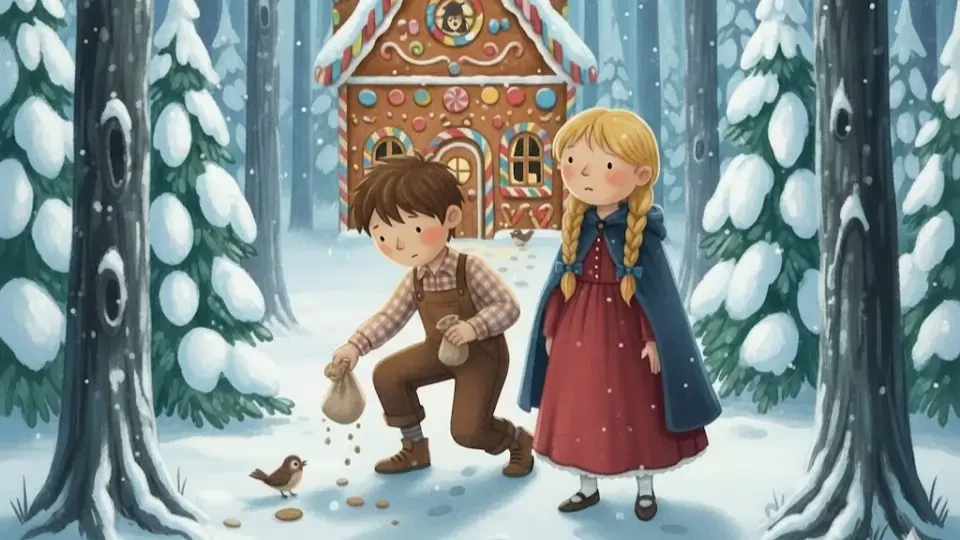
On the edge of a great, deep forest, so vast that no one had ever found its end, stood a small log cabin, built of rough timber and moss. Here lived a poor woodcutter with his two children, Hansel and Gretel, and his second wife, their stepmother.
Times had turned hard. A great famine had settled over the land, and however early the woodcutter rose to swing his axe, he could no longer bring home enough bread for four mouths. Night after night, the family went to bed with empty stomachs, and the stepmother's fear of starving slowly hardened into something cruel.
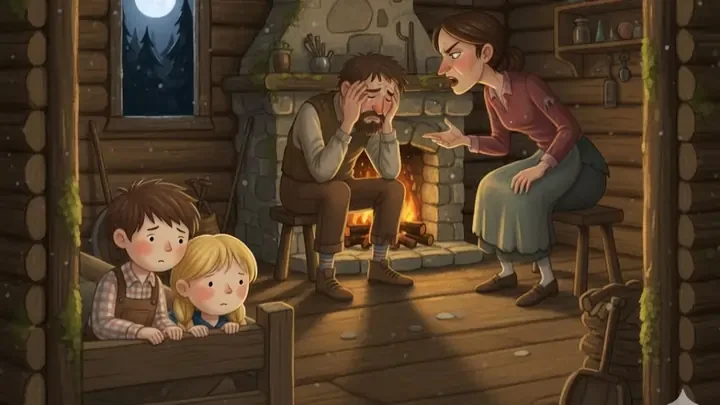
One night, when the moon hung cold and thin over the treetops and its pale light crept in through the cracks in the timber wall, the stepmother turned to her husband by the dying fire.
"Husband," she said, her voice as dry as autumn leaves, "you know as well as I do that we have nothing left, not even a crust of bread to share between the four of us. Tomorrow, before first light, we must take the children deep into the forest, to the thickest part of it, and leave them there. We cannot feed them any longer -- and if we do not do this, we will all starve, every one of us."
The woodcutter went pale and sank onto his stool.
"Wife, I cannot do that," he said, his voice breaking. "How could any father lead his own children into the forest and leave them there alone? The wild animals would tear them to pieces before nightfall."
"Then you are a fool," she snapped, "and we will all four starve together. Think, husband -- there is no other way."
She gave him no peace until, worn down and heartsick, he agreed.
In the small room beside the hearth, Hansel and Gretel had heard every word through the thin wall, and Gretel began to cry softly into her pillow.
"Hush, Gretel, don't cry," Hansel whispered, slipping his hand into hers. "I heard everything. Sleep now -- I know what to do, and I promise you, I will not let us be lost."
He waited until his father and stepmother were both asleep, then lifted the wooden latch as quietly as a mouse and crept out into the cold. The moon was bright that night, and the white pebbles scattered outside the cabin door shone like silver coins in the grass. Hansel filled both his pockets until they could hold no more, then crept back inside to his sister's side.
"Now go back to sleep, Gretel," he said gently. "God will not abandon us."
Chapter 2: The Trail of White Pebbles 🌕
When morning came, the stepmother woke the children roughly.
"Get up, you lazybones! We are going into the forest to gather wood. Here -- a little bread for each of you, but mind you save it for midday, for there will be no more."
Gretel carried the bread carefully in her apron, since Hansel's pockets were already full of pebbles. Together the family set off into the forest, and as they walked, Hansel kept turning back as if to look at the cabin.
"Hansel, why do you keep stopping? Walk on, and mind your feet," his father said.
"I'm only looking back at my little white cat, Father, sitting on the roof to say goodbye to me," Hansel answered.
But in truth, each time he stopped, he was slipping a shining white pebble from his pocket and letting it fall softly onto the path behind him.
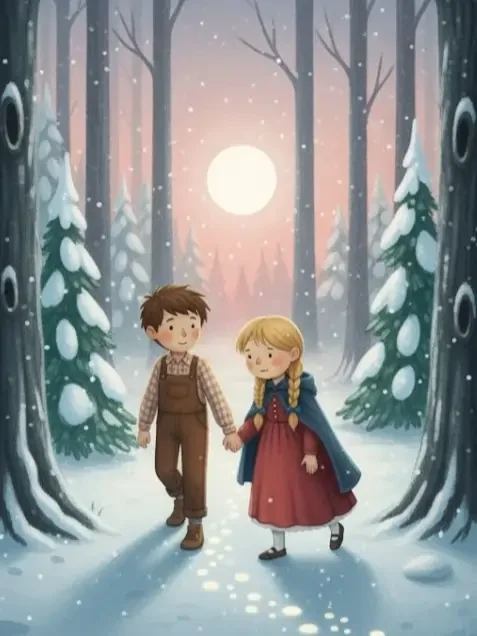
They walked deeper and deeper, until they reached the very heart of the forest, where the trees stood so close together that hardly any daylight reached the ground. There the father built a fire and told the children to sit beside it and rest.
"Sleep now, children. Your stepmother and I are going further to cut wood, and we will come back for you this evening."
Hansel and Gretel sat by the fire, and at midday they shared their small piece of bread. Now and then they heard what sounded like the strokes of an axe nearby, and it comforted them to think their father was close -- though it was only a dead branch, tied by the wind, knocking against a hollow trunk.
The hours passed. The fire burned low, and no one came. Evening fell, and then full darkness, and still the children sat alone. Gretel began to cry.
"How will we ever find our way out of the forest now?"
"Wait just a little, until the moon rises," Hansel said, though his own heart was pounding. "Then we will find the way."
When the full moon finally climbed above the trees, Hansel took his sister's hand.
"Look, Gretel -- there. The white stones are shining like coins in the moonlight. Follow me, and we will not lose our way."
They followed the little pebbles, one gleaming stone after another, walking all through the night, until at last, just as dawn broke, they came again to their father's door and knocked. When the stepmother opened it and saw them standing there, her face went hard with fury, though she said only that they were wicked children to have stayed so long in the forest. Their father, watching from behind her, felt nothing but relief flood through his tired heart, for he had grieved bitterly at having left them.
Chapter 3: Lost in the Deep Forest 🌲
Not long after, the same hunger crept back into the house, worse than before. One night, again through the thin wall, the children heard their stepmother's voice.
"The children must go. Everything is eaten but half a loaf, and after that, the song is over. Tomorrow we take them further into the forest than before -- so far this time that they will never find their way back to us. It is the only way left."
The woodcutter's heart felt heavier than a stone in his chest, but he no longer had the strength to argue.
Hansel waited until the house was quiet, meaning to slip out and gather pebbles as before -- but when he reached for the latch, he found the door bolted fast from the outside. Still, he comforted his sister.
"Don't cry, Gretel. Sleep now, and trust me -- I will find a way, just as before."
In the morning, the stepmother pressed a piece of bread into each child's hand, smaller even than the last time. As they walked, Hansel broke his own piece slowly in his pocket, and every few steps he let a crumb fall to mark the path behind him, just as he had done with the pebbles.
"This time we must be even more careful, Gretel," he whispered. "But the trail is there. I promise you."
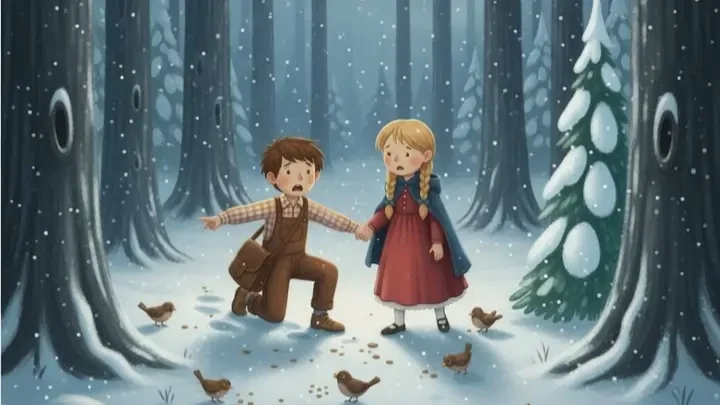
They walked on, further than they had ever walked before, deeper than either child had known the forest could go, until at last they reached a part of it neither had ever seen. Once again their father lit a fire and told them to sleep, promising to return by evening; once again, evening came and went, and no one returned.
When the moon rose and Hansel led his sister to look for the crumbs, they found nothing -- for the many birds that lived in the forest and fields had followed them all day and pecked up every last crumb from the ground.
"We will find the way, Gretel," Hansel said, though for the first time his voice trembled too.
But there was no way to find. For two full days and two long nights they wandered through the endless trees, eating only the few berries they could reach, growing wearier and more afraid with every hour, until their small legs could barely carry them another step, and they lay down beneath a tree, wondering if they would ever rise again.
Chapter 4: The House of Bread and Sugar 🍬
On the morning of the third day, as the children dragged themselves onward, a small snow-white bird appeared on a branch above them, singing so sweetly that they stopped to listen. When it took flight, they followed it without quite knowing why, until it led them to a little clearing -- and there, in the middle of it, stood a house unlike any they had ever seen.
Its walls were built of bread, its roof was tiled with cake, and its windows were made of clear, glittering sugar.
"Look, Gretel!" Hansel cried, his eyes wide. "Let us eat, and have a fine meal for once! I will have a piece of the roof -- you try the window, it looks sweet."
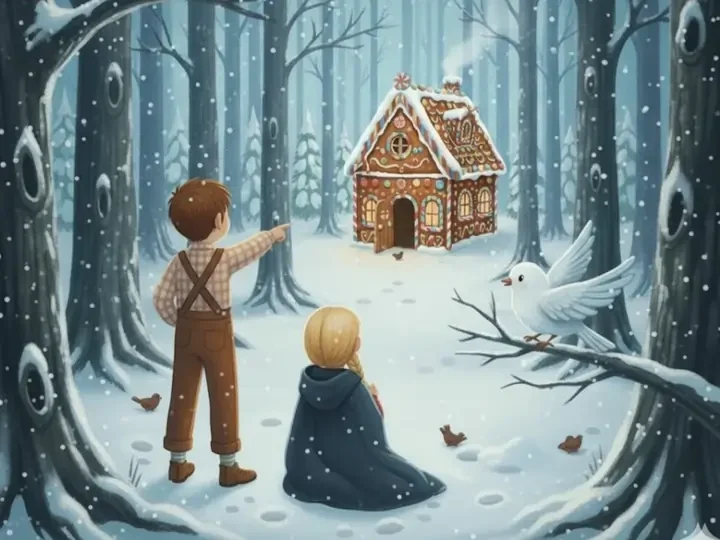
Hansel broke off a piece of the roof to see how it tasted, while Gretel pressed herself against a windowpane and nibbled at it. They had eaten only a few bites when a thin voice called out from inside the house:
"Nibble, nibble, little mouse, who is nibbling at my house?"
The children froze -- but then answered together, as sweetly as they could:
"It is only the wind, only the wind, the child of heaven blowing by," they said, and went on eating without a moment's worry, for the bread tasted better than anything they had eaten in weeks.
Then, all at once, the door of the little house swung open, and out came a very old woman, leaning on a crutch. Hansel and Gretel were so startled that they dropped what was in their hands -- but the old woman only shook her head and smiled.
"Well now, dear children, however did you come here? Come in, come in, and stay with me a while. No harm will come to you here."
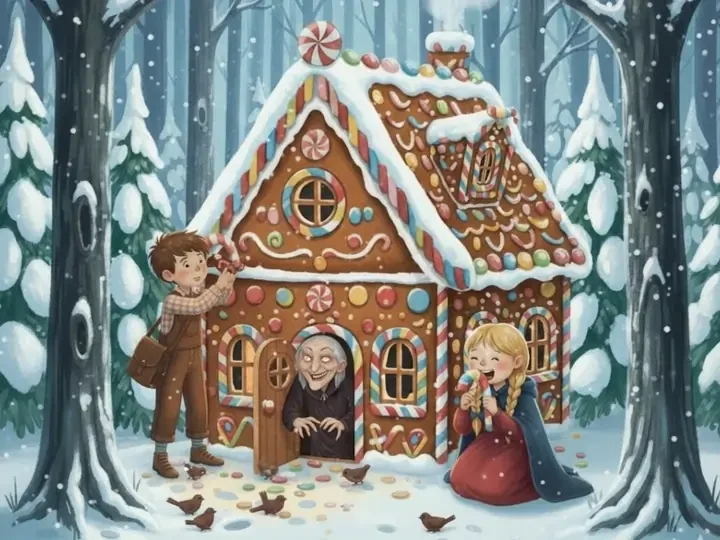
She took them each by the hand and led them inside, where she had already set out a fine meal of milk, pancakes with sugar, apples, and nuts, and afterward showed them to two small beds made up with clean white linen. Hansel and Gretel lay down and slept as though they had found heaven itself.
But the old woman had only pretended to be kind. In truth she was a wicked witch who had built her house of bread purely to lure children close, and though her eyes were weak and she could hardly see, she had a sense of smell as keen as any animal's, and always knew the moment a child came near.
Chapter 5: The Witch's Cage 🔒
Early the next morning, before the children had even opened their eyes, the witch was already standing over their beds, looking at their round, rosy cheeks with a hungry little smile.
"What a fine mouthful they will make," she murmured to herself.
Without warning, she seized Hansel with her withered hand and dragged him out to a small cage in the yard, where she locked him behind a barred door, no matter how he cried out. Then she shook Gretel roughly awake.
"Get up, lazy girl! Fetch water and cook something good for your brother. He is out in the cage, and he must be made fat. Once he is fat enough, I will eat him."
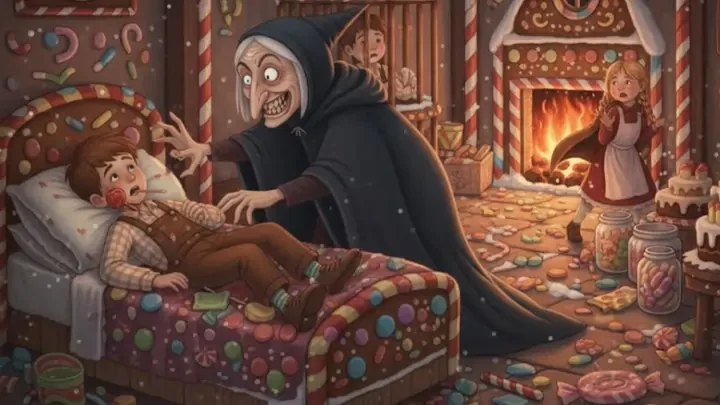
Gretel wept until her tears ran dry, but there was no one to hear her, and in the end she had no choice but to obey, and to cook whatever the witch demanded for her brother, while she herself was given nothing but crab shells to eat.
Every morning, the old witch hobbled out to the cage and called through the bars:
"Hansel, stick out your finger, so I can feel whether you will soon be fat enough."
But Hansel, who was clever even in his fear, always held out a little bone instead of his finger. The witch's eyes were so weak that she could not tell the difference, and she would frown and mutter to herself.
"Strange -- still so thin! Well then, more porridge for him, Gretel, and be quick about it!"
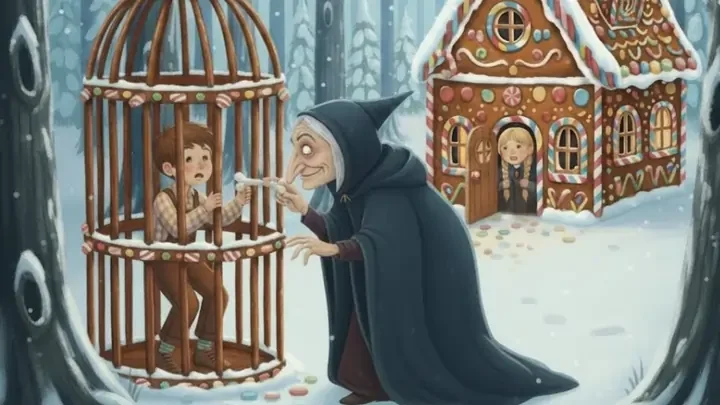
Week after week went by this way, and still the witch believed Hansel had grown no fatter, though in her heart she began to suspect she was being tricked.
Chapter 6: Into the Oven 🔥
After four long weeks, the witch's patience finally broke.
"Enough waiting!" she snapped at Gretel. "Fat or thin, tomorrow I will kill Hansel and cook him, whatever he looks like."
That evening, poor Gretel had to carry the water and light the great oven fire, weeping bitterly all the while.
"Dear Lord, help us now," she whispered, "for if only the wild animals in the forest had eaten us, at least we would have died together."
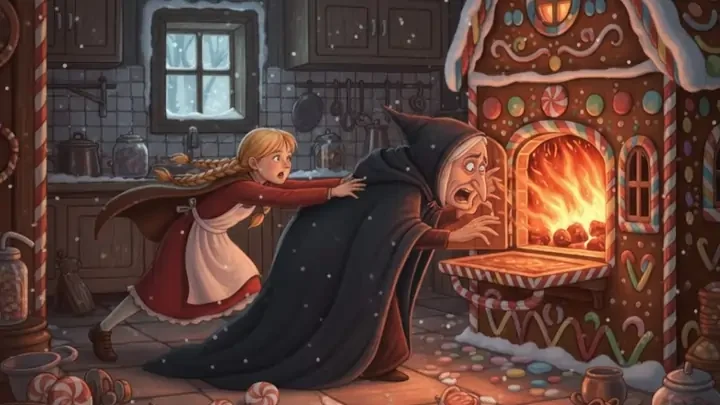
"Save your tears," the witch said the next morning, dragging Gretel outside to where the oven already glowed red-hot. "Crawl in and tell me if it is hot enough yet to bake the bread."
For the witch meant, once Gretel had crawled inside, to shut the door and roast her too. But Gretel understood the wicked plan at once.
"I'm not sure how to do it," she said, twisting her apron in her hands. "How do I get in there?"
"Silly goose!" the witch cried, losing all patience. "The opening is plenty wide -- see, even I could fit through it myself!"
And to show her, the old witch shuffled closer and stuck her own head and shoulders into the mouth of the oven. In that very instant, Gretel gathered every last bit of her strength and gave her a mighty push, sending her tumbling all the way inside. Then she swung the iron door shut and dropped the bolt into place, and the wicked witch's power over them was ended forever.
Chapter 7: The Journey Home 🏡
Gretel ran straight to the cage and threw open the door.
"Hansel, we are free! The old witch is dead!"
Hansel sprang out like a bird let loose from its cage, and the two children fell into each other's arms, laughing and crying all at once. With nothing left to fear in the little house, they searched it from corner to corner and found, tucked away in an old chest, a great store of pearls and precious stones.
"These are even better than pebbles," Hansel said, filling his pockets until they could hold no more, while Gretel gathered up as much as her apron would carry.
At last they set off to find their way home, and after walking for some hours, they came to the edge of a wide stretch of water, with no bridge and no boat in sight to carry them across.
"We cannot cross, and there is no path around it," Gretel said, looking at the water stretching before them.
"But look -- there swims a white duck," said Hansel. "Perhaps she will help us across, if we ask her kindly."
Together the children called out:
"Little duck, little duck, here stand Gretel and Hansel too. No bridge and no boat can we see -- won't you carry us over, please?"
The duck swam gently to the bank, and Hansel climbed on first and asked his sister to sit beside him. But Gretel, ever thoughtful, said it would be too heavy a load for the little bird, so the duck carried them across one at a time instead. Safely on the other side, the children walked on and on, until the forest grew more and more familiar, and at last they caught sight of their father's cabin in the distance.
They began to run.
"Papa! Papa!" cried Hansel.
"Papa! Papa!" cried Gretel.
Their father, who had not known a single day of peace since he had left them in the forest, ran to meet them with tears streaming down his face. He told them their stepmother had gone from the house and would trouble them no more, and that he had spent every day since regretting what he had done.
"I will never, ever leave you again, my dears," he said, holding them both close.
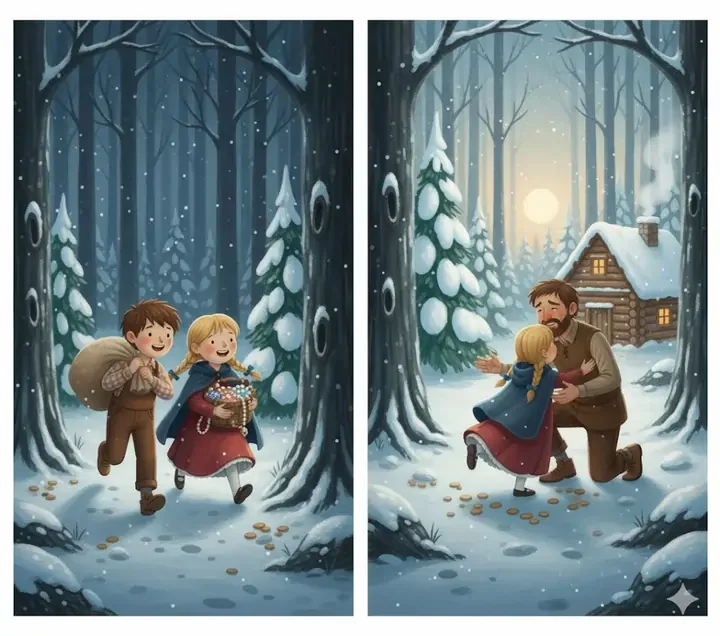
Hansel emptied his pockets, and Gretel shook out her apron, until pearls and jewels rolled and scattered across the cabin floor like a small, glittering sea. Never again would the family know hunger. The woodcutter sold enough of the treasure to buy them a fine, sturdy house, and there Hansel and Gretel grew up safe and loved beside their father, and though they never forgot the dark days in the forest, they remembered above all that they had found their way home together.
THE END

✨ The Moral of The Tale of Hansel and Gretel
What's the most important thing we can learn from the tale of Hansel and Gretel? The story gives us several important truths:
- Together we are strongest: When the children were alone, they were afraid. But when they stuck together and trusted each other, they managed to overcome the wicked witch. The love and bond between brother and sister were their greatest strength.
- Cunning overcomes evil: Gretel's seemingly innocent question fooled the blind witch. This shows that you don't always need strength to defeat evil. Cunning and courage are far more powerful.
- Never give up hope: Despite hunger, fear, and captivity, Hansel and Gretel never lost hope of finding their way home and being reunited with their father. There's always light, even in the darkest forest.
🌟 More About the Tale of Hansel and Gretel
This classic fairy tale is a timeless story that has survived for centuries. It's one of the most discussed tales by the Brothers Grimm, offering a rich look at themes like poverty, endurance, and the nature of evil. The story of Hansel and Gretel has inspired many artistic works, including the famous opera by Humperdinck.
Whether you read this as a thrilling scary tale around Halloween, or as part of studying fairy-tale literature, the story remains a powerful reminder of the strength of a sibling's love. For those who want to explore further, there are many visual interpretations, illustrations, and beautiful storybook art inspired by this classic tale.


 English
 Norsk
Norsk Svenska
 Dansk
Dansk Deutsch
 Nederlands