

Cinderella loses her mother, becomes a servant in her own home, and is helped by a fairy godmother to attend the palace ball.
This is Charles Perrault's classic 1697 version of Cinderella, complete with the glass slipper, the fairy godmother, and the royal ball that changes everything — the story much of the world still recognizes today.
👠Cinderella by Charles Perrault
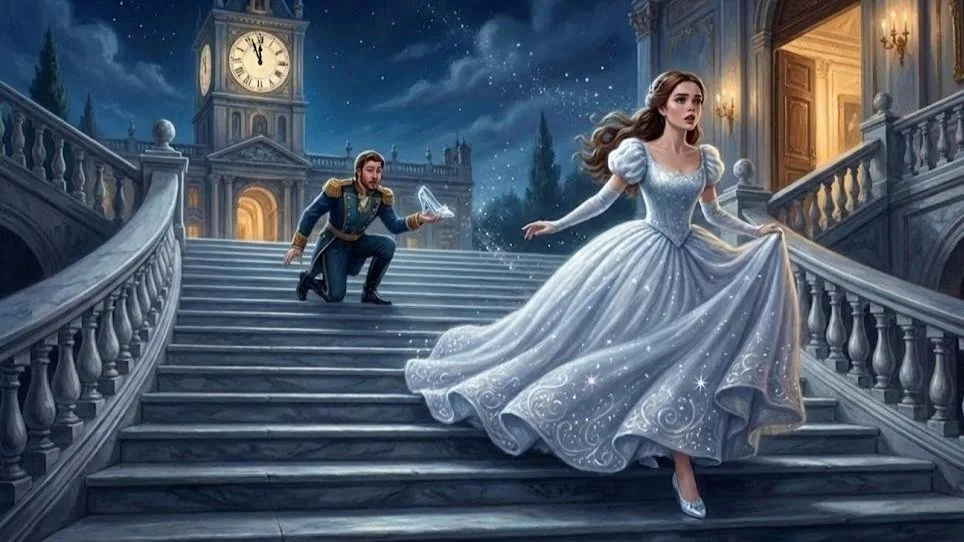
This is the classic original version, the one many people know today.
❤️ The Loss of Her Mother and the Arrival of the Stepmother
Once upon a time there was a rich man who had a beautiful and kind daughter. They lived in a large house with gardens full of flowers and servants who took care of everything. But more than anything, this man loved his wife, a good and loving woman who taught her daughter the value of kindness, humility, and courage.
But misfortune came like a dark shadow one cold winter evening. The mother fell ill, and no doctor could cure her. On her deathbed, she took her daughter's hand between her own weak hands and said:
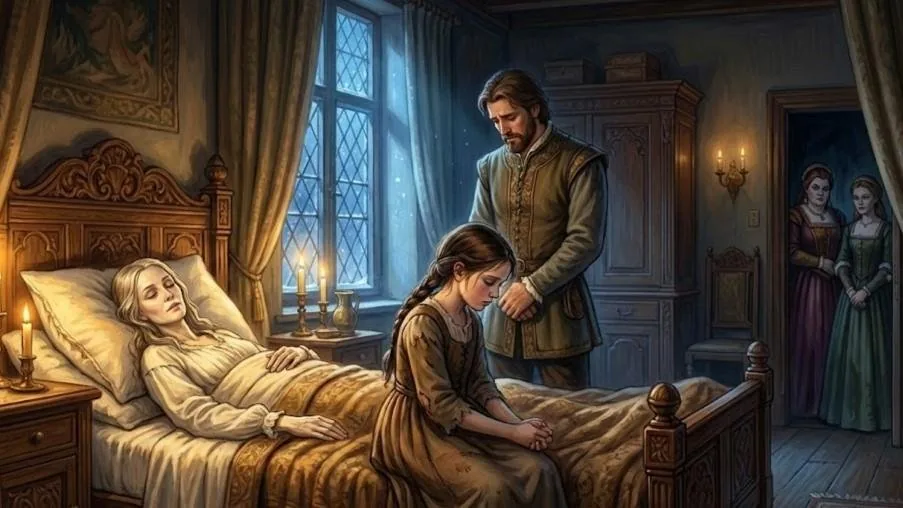
"My dear daughter, always remember this: be good and brave, and happiness will always follow you. Even when life is hard, you must never lose the goodness in your heart."
And with those words, she closed her eyes forever.
The poor girl cried for days, and her father was so sad that he didn't know how he would go on. But after a year, he decided to remarry, for he believed his daughter needed a mother in the house.
His new wife was a proud and cold woman with two daughters of her own. On the outside she looked elegant and fine, but inside her heart there was nothing but selfishness and pride. Her daughters were just the same: lazy, vain, and with hearts as hard as stone. They looked beautiful in their fine dresses and curled hair, but inside they were ugly.
From the very first day, the stepmother looked at her stepdaughter with envy. The girl wasn't only beautiful on the outside — she was good, and that goodness shone through her face like sunlight through a window. This the stepmother could not bear.
"Why should this girl have everything?" she whispered to her daughters. "We'll show her where she belongs."
🧹 Life as a Servant in Her Own Home
After her father's death — for the poor man died too, not long after — the stepmother showed her true face. She took away all the girl's fine clothes, her beautiful rooms, and all the joys she had once had.
"From now on you will sleep in the attic, in the cold corner by the chimney," said the stepmother coldly. "And my daughters shall have these fine dresses. You don't deserve them."
The girl was given only ragged clothes to wear, and had to work from early morning until late at night. She washed floors, scrubbed stairs, cooked meals, sewed, knitted, and washed clothes for the three wicked women. When all the work was done, she would sit in a corner by the kitchen hearth, among the ashes and soot, for there, at least, it was warm.
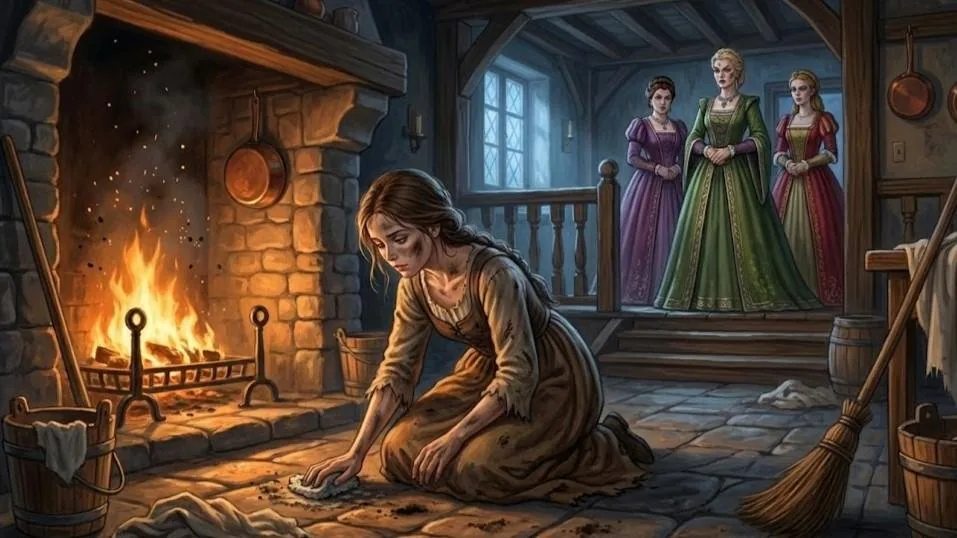
Her stepsisters laughed at her and called her Cinderella, because she always had ashes on her face and on her old, worn-out clothes.
"Look at Cinderella!" laughed one stepsister. "She looks like a beggar!"
"She fits perfectly by the hearth," said the other. "That's where the likes of her belong."
But even though they treated her this way, Cinderella never complained. She remembered her mother's words: "Be good and brave." So she did her work with a smile, was kind to the animals in the house, helped without being asked, and sang quiet songs when she was alone.
In the evenings, when everyone else was asleep, she would sit by the hearth and gaze into the flames. There she saw her mother's face, and felt that she wasn't entirely alone.
✨ The Invitation to the Ball and Help from the Fairy Godmother
One day a servant from the palace came riding through the town. He stopped at every house and handed out beautiful, gilded invitations. When he came to the house where Cinderella lived, the stepmother received it with a false smile.
"A royal ball!" she exclaimed loudly. "The prince is to choose a bride! This is our chance, daughters!"
The whole house was turned upside down. The stepsisters demanded new dresses, new shoes, new jewelry. Cinderella had to sew, press, and arrange everything. She helped them set their hair, mend their dresses, and fix their ribbons and laces.
"Cinderella, can't you help me with this?" complained one sister. "You're so good at it!"
"Cinderella, you must fix my curls! They're not sitting right!" ordered the other.
Cinderella did everything they asked, without complaint. But when evening came, and the stepmother and stepsisters stood ready in their finest clothes, Cinderella dared to ask, timidly:
"May… may I come to the ball too?"
The stepsisters burst out laughing.
"You?! To the ball?! With ashes in your hair and rags on your body?!"
The stepmother turned to her coldly:
"You may come the day you have a dress worthy of a palace, shoes fit for a princess, and a face without soot. So, never."
And with that, they left the house in a magnificent carriage, leaving Cinderella behind alone.
The poor girl went out into the garden and sat by her mother's grave, beneath a great tree they had planted together. There she cried so bitterly that her tears fell like rain onto the ground.
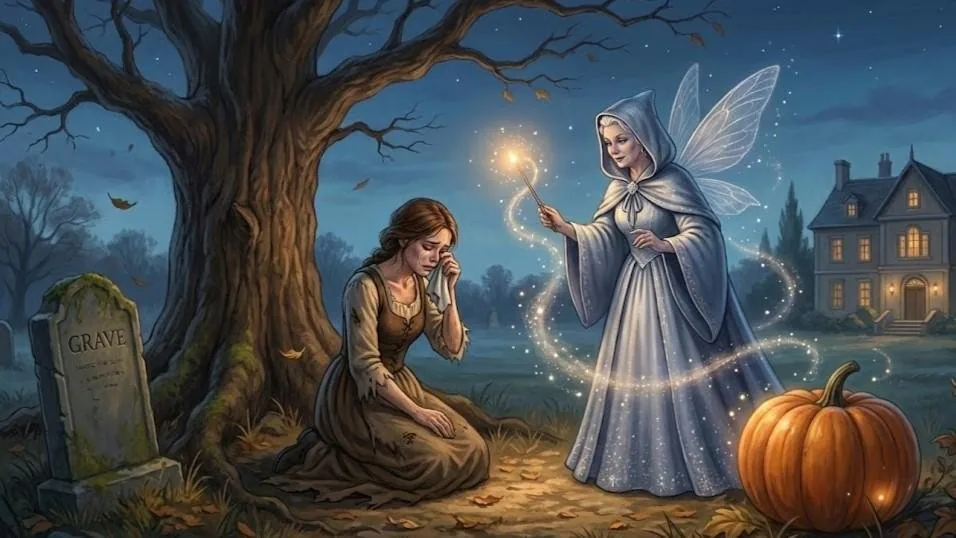
"Why is life so unfair? I only wish to see the ball… just once…"
Suddenly, as if the air itself had shimmered, an old woman stood before her. She was dressed in a long, glittering cloak, and in her hand she held a wand that glowed faintly in the evening dark. Her eyes were warm and kind.
"Why are you crying, my child?" she asked gently.
"I… I wish to go to the ball, but I have nothing to wear," answered Cinderella between sobs.
The old woman smiled.
"I am your fairy godmother, and I have come to help you. But first: can you fetch me a pumpkin from the kitchen garden?"
Cinderella, confused but obedient, ran off and returned with the largest pumpkin she could find. Her godmother took her magic wand, spun it three times around the pumpkin, and said:
"Bibbidi-bobbidi-boo!"
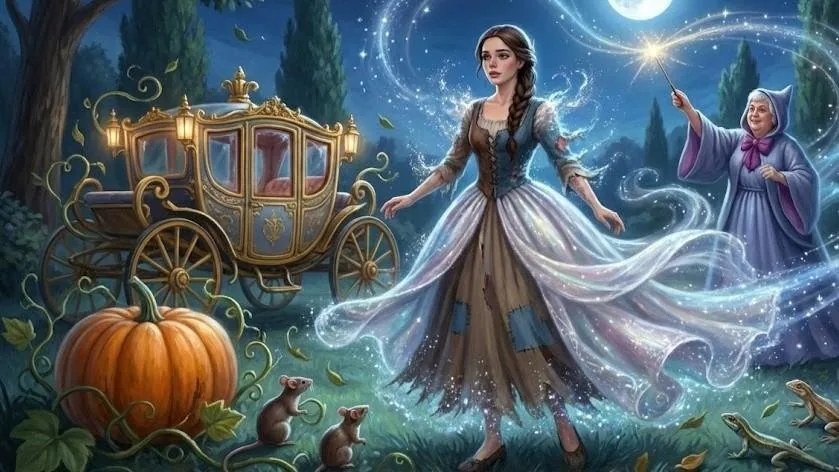
In the blink of an eye, the pumpkin transformed into a magnificent carriage made of gold and crystal, so beautiful that even the moon looked pale beside it.
"Now we need horses," said the godmother. "Find me six mice from the mousetrap."
Cinderella fetched six little mice. The godmother spun her wand again — and the mice became six white horses with manes like silk.
"And a coachman?" asked Cinderella, breathless with wonder.
"Find me a rat."
And the rat became a splendid coachman with a moustache and a top hat.
"And finally… six lizards from the pond."
The lizards became six footmen dressed in uniform.
Cinderella stood speechless.
👗 The Magical Transformation and the Journey to the Palace
But the godmother wasn't finished. She looked Cinderella up and down and shook her head.
"You cannot go to the ball looking like that, my child."
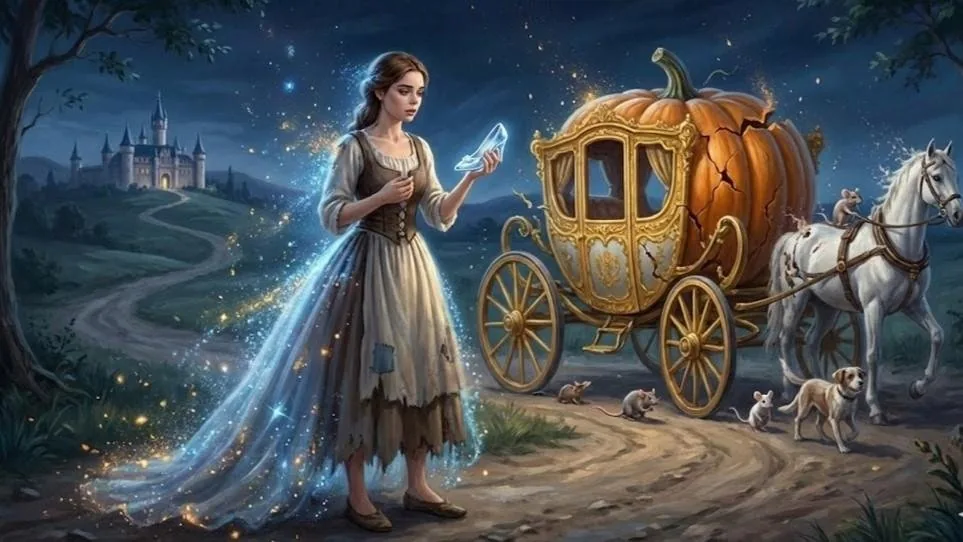
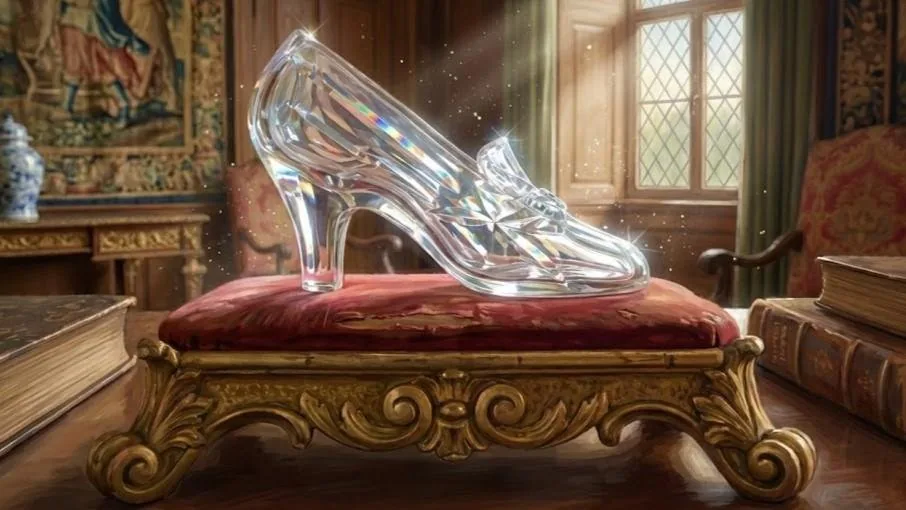
She spun the wand once more, and Cinderella felt her old, worn-out clothes vanish. In their place she was dressed in the most beautiful gown anyone had ever seen: made of silver and light, embroidered with stars and moonlight. The gown was so fine it looked as though it had been woven from dreams. And on her feet — two small, glittering glass slippers, sparkling like diamonds.
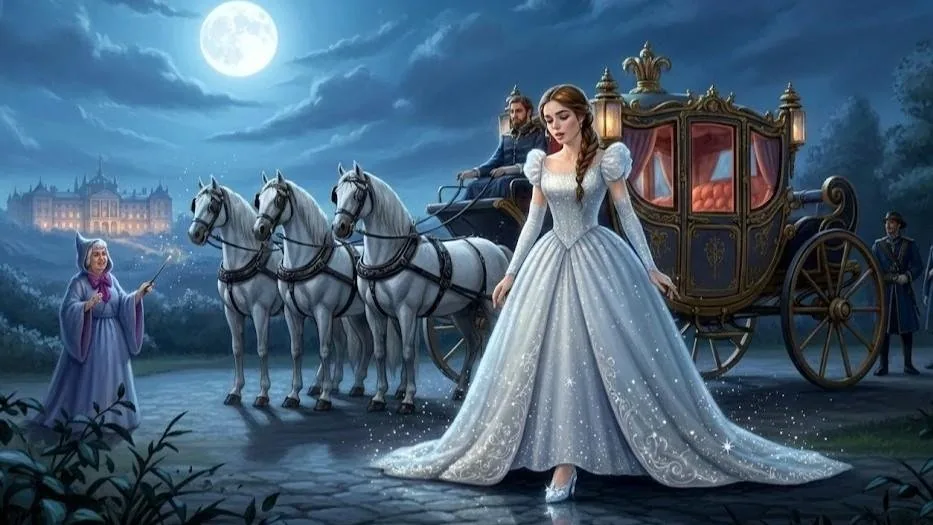
Cinderella looked at her reflection in the mirror-smooth carriage and could hardly believe it was her.
"Is this… really happening?" she whispered.
"It is magic," said the godmother gravely. "But listen closely: the magic lasts only until midnight. When the clock strikes twelve, everything will return to what it was: the carriage will become a pumpkin, the horses will become mice, and the gown will become rags. You must leave the ball before the clock strikes twelve. Do you promise me that?"
"I promise!" said Cinderella solemnly.
"Then you may go. And remember: goodness is the most beautiful garment you can wear."
With that, Cinderella climbed into the carriage, and the horses galloped off toward the palace. Her heart pounded with excitement, joy, and a little fear.
💃 The Ball with the Prince and the Midnight Flight
As the carriage rolled onto the palace grounds, all the music stopped. Everyone turned to look. Who was this mysterious princess arriving in a carriage of gold?
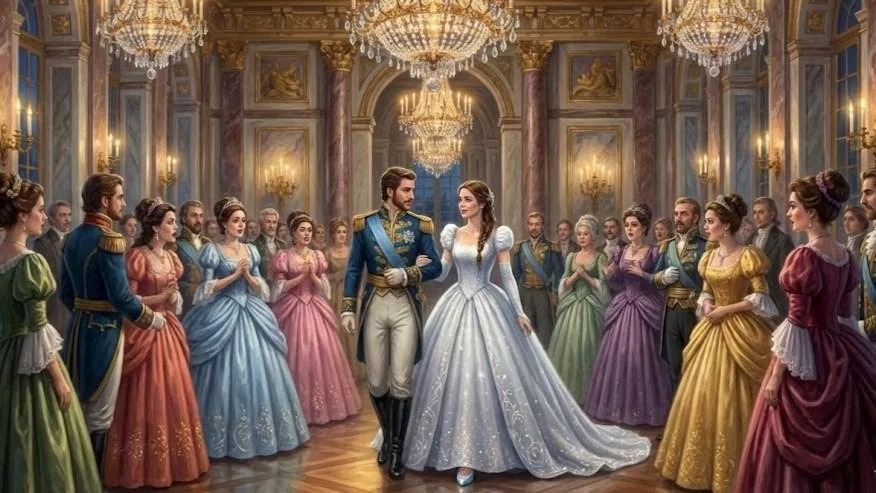
The prince himself came down the stairs to receive her. He had never seen anyone so beautiful — not because of the gown, but because of the goodness that shone from her eyes.
"Allow me," he said gently, and offered her his hand.
Cinderella took it, and together they walked into the hall.
They danced all evening. The prince danced with no one else. The stepsisters watched the unknown princess with envy, but didn't recognize her.
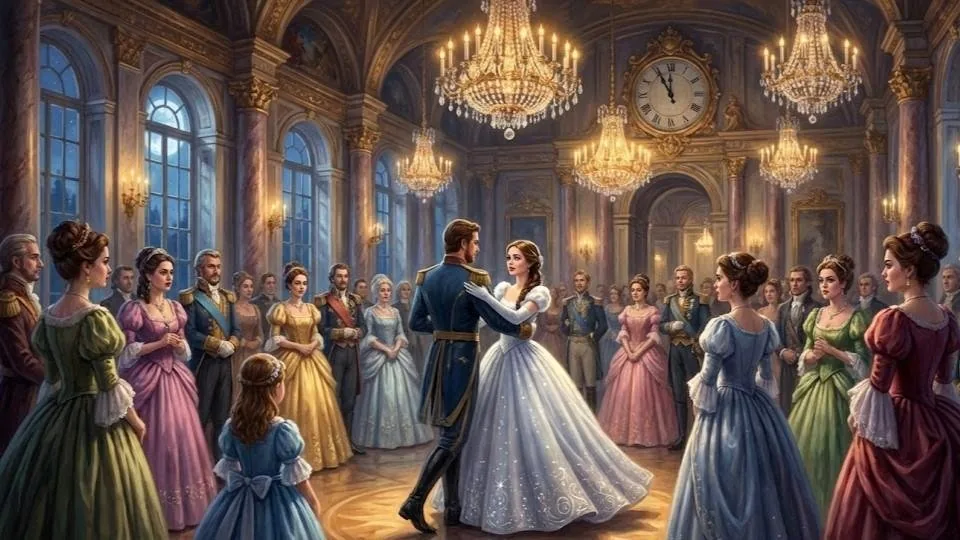
"Who is she?" whispered one.
"No one knows," answered the other bitterly. "But the prince can't take his eyes off her."
Cinderella was so happy that she forgot the time. She danced, she laughed, and felt alive for the first time in many years.
But suddenly she heard the first strike from the tower clock.
BONG.
Midnight!
She tore herself away from the prince and ran down the stairs as fast as her legs would carry her. Behind her she heard him call out:
"Wait! I don't even know your name!"
BONG. BONG.
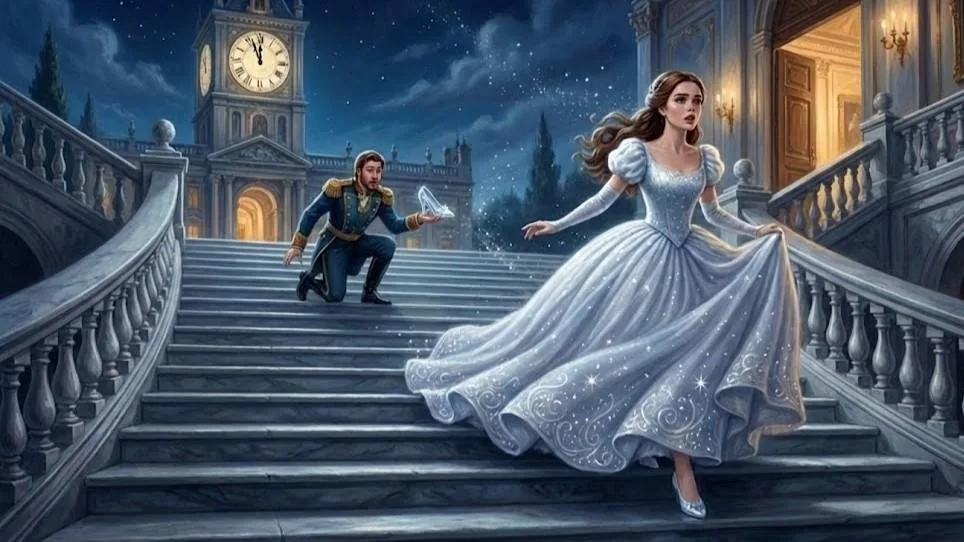
Cinderella ran faster. But in her haste she lost one glass slipper on the stairs. She had no time to turn back. The carriage was already beginning to crumble.
BONG. BONG. BONG.
She leapt into the carriage just as the twelfth chime struck.
BONG!
And everything turned back into what it had been: pumpkin, mice, rat, lizards. Cinderella was left standing on the road in ragged clothes — but with one glass slipper still in her hand.
Behind her she saw the prince standing on the palace steps, holding the other glass slipper.
👠 The Search for the Glass Slipper
The next day, the whole kingdom was talking about the mysterious princess who had vanished at midnight. The prince was in love — but he had no idea who she was.
"I must find her," he told his father, the king. "She is the only one I wish to marry."
The king issued a decree: every girl in the kingdom was to try on the glass slipper. Whoever it fit would become the prince's bride.
Servants traveled from house to house with the slipper on a velvet cushion. Girls everywhere tried to squeeze their feet into it. But the glass slipper was small, delicate, and shaped to fit only one foot.
When the servants arrived at Cinderella's house, the stepsisters tried desperately. One pressed and squeezed, the other screamed in pain — but neither of them could get it on.
"Are there no other girls in the house?" asked the servant.
"No," said the stepmother quickly. "No one else."
But then a voice was heard from the kitchen:
"I… I would like to try too."
Cinderella stepped out of the shadows. The stepsisters laughed.
"Her?! She wasn't even at the ball!"
But the servant looked sternly at them:
"The king's order says every girl. She shall try too."
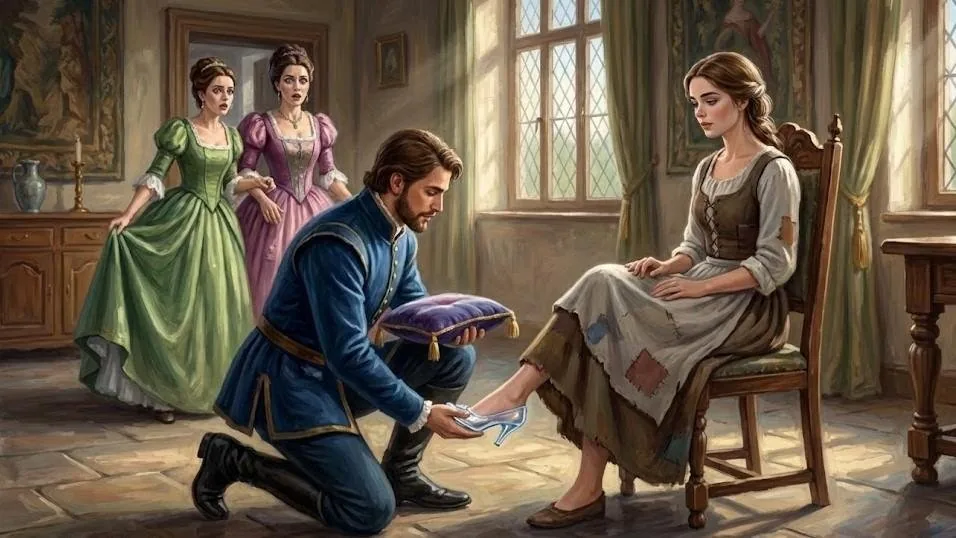
He made to fetch the glass slipper — but just as he was about to kneel, a firm voice sounded from outside.
"Wait!"
Everyone turned. Outside stood the royal carriage, and the prince himself stepped down.
He had been watching from the carriage, and when his eyes fell on the young girl stepping out from the shadows, he stopped still.
"The last girl," he said calmly, but with a spark in his eyes. "I will place the glass slipper on her myself."
Silence fell over the room.
The prince walked over to Cinderella and knelt before her. Gently, he lifted the glass slipper and guided it toward her foot.
It slid into place — as though it had always belonged there.
The stepsisters gasped. The stepmother turned deathly pale.
And then Cinderella calmly took out the other glass slipper from her pocket.
💍 Reunion and the Happy Ending
When he saw Cinderella — even in her worn-out clothes, with soot on her cheek — he recognized her at once.
"It's you," he whispered. "You're the one I danced with. You're the one I've been searching for."
He knelt before her and said:
"Will you be my wife?"
And Cinderella, with tears of joy in her eyes, said:
"Yes."
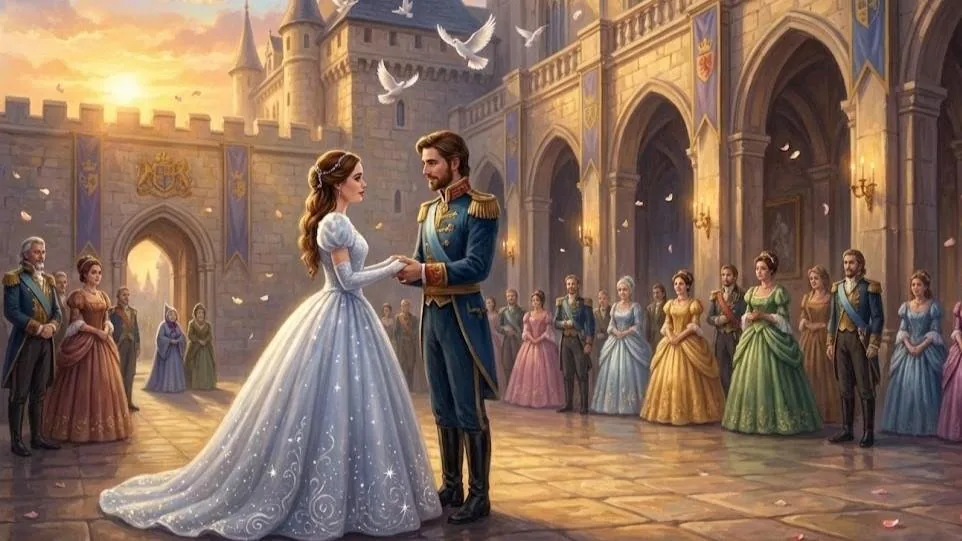
The wedding was celebrated with great splendor. The whole kingdom rejoiced, and Cinderella — now a princess — forgave the stepmother and stepsisters. For she always remembered her mother's words:
"Be good and brave, and happiness will always follow you."
And she lived happily ever after.
THE END

THE MORAL: Why the Cinderella Story Matters
The Cinderella fairy tale teaches us that goodness always triumphs over cruelty, that patience is rewarded, and that true beauty comes from the heart — not from clothes or titles. Even when life is unfair and heavy, humility, kindness, and courage can change everything. That's why the story of Cinderella remains one of the most read tales in the world.
This is a timeless fairy tale for children that reminds us that honesty and goodness always find their reward, even when the road is long.
Frequently Asked Questions About Cinderella
Who wrote Cinderella?
The most famous original Cinderella story was written by the French author Charles Perrault in 1697, published in the collection Contes de ma mère l'Oye (Mother Goose Tales). It was Perrault who introduced the fairy godmother, the pumpkin carriage, and the glass slipper.
There is also a German version called Aschenputtel by the Brothers Grimm (1812), which is darker and more brutal. In the Grimm version there is no fairy godmother — instead, magical birds help Cinderella, and the stepsisters cut off their toes and heel to try to fit into the shoe.
Why is the slipper made of glass?
This is one of the most debated questions! Some believe that Perrault originally wrote "pantoufle de vair" (fur slipper), but that it was mistakenly written as "pantoufle de verre" (glass slipper). But most scholars believe Perrault deliberately chose glass because it symbolizes purity, fragility, and exclusivity — only one foot could ever fit it perfectly.
What's the difference between the Brothers Grimm's Cinderella and Perrault's version?
The version we know best today is Perrault's version, because Disney used it as the basis for their film.
Is Cinderella based on a true story?
No, but the Cinderella motif appears in hundreds of cultures around the world. The oldest known version comes from China (around 850–860 CE), called Ye Xian, in which a magical fish helps the main character. There are also Egyptian, Greek, and African versions.
The theme — an oppressed person who receives magical help and finds happiness — is universal.
Cinderella on Film and Disney: The Difference from the Original Fairy Tale
Disney's version made Cinderella one of the world's most famous princesses.
Disney's Cinderella (1950)
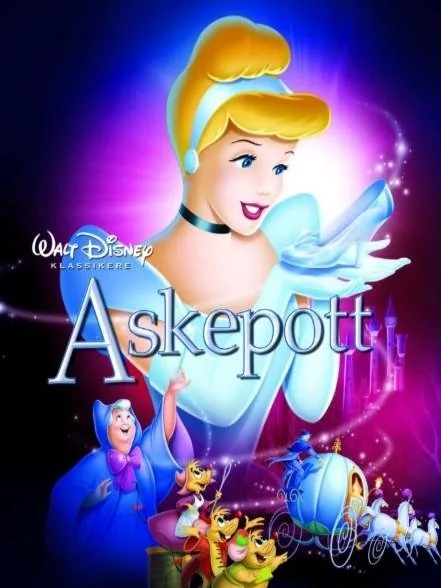
Walt Disney's animated Cinderella film from 1950 is one of the most famous adaptations in history. Disney based the film on Perrault's version, but made some important changes:
What Disney added:
- The mice Jaq and Gus (Cinderella's helpers and friends)
- The cat Lucifer (the stepmother's evil cat)
- The song "Bibbidi-Bobbidi-Boo"
- More focus on humor and talking animals
- Less focus on the moral — more on magic and romance
What Disney kept from the original:
- The fairy godmother
- The pumpkin carriage
- The glass slipper
- The ball and the midnight deadline
- The good, patient Cinderella
What Disney softened:
- The stepmother and stepsisters are wicked, but not violent
- No cruel punishments (as in the Grimm version)
- A more "family-friendly" tone
Other Well-Known Films and Adaptations
- Cinderella (2015) – Live-action Disney film starring Lily James
- Ever After (1998) – A historical version without magic
- A Cinderella Story (2004) – A modern high-school version
- Into the Woods (2014) – A darker musical version
The 1950 Disney version remains the most iconic, and has turned the glass slipper, the fairy godmother, and the "midnight rule" into symbols everyone recognizes.

 English
 Norsk
Norsk Svenska
 Dansk
Dansk Deutsch
 Nederlands