


A cursed spinning wheel, a hundred years of sleep, and a kiss that wakes an entire castle -- the classic story of Sleeping Beauty, told faithfully to Perrault and the Brothers Grimm, with a full look at the tale's origins and versions.
Sleeping Beauty is a classic tale for children about a princess, a curse, and a sleep that lasts a hundred years. In this telling, we meet the king and queen, the good fairies and the uninvited one, the spinning wheel that pricks, the thick hedge of thorns, and a warm awakening. The story is written for reading aloud, giving school-age children the mix of excitement, humor, and safety they expect from a timeless fairy tale.
The story of Sleeping Beauty has roots in the European storytelling tradition. Although the question of who wrote Sleeping Beauty is often asked, it was Charles Perrault and the Brothers Grimm who made it best known. Earlier still, Giambattista Basile wrote an Italian variant (Talia).
We know this fairy tale as Sleeping Beauty, which means "Sleeping Rose" or "Thorn Rose." However, stage and film versions, like the ballet, often use the name Aurora.
The Tale: Sleeping Beauty
Once upon a time, there was a king and queen who ruled over a peaceful kingdom with lush meadows, orchards, and clear rivers. Their greatest wish was for a child, but the years went by, and the wish went unfulfilled. Often the queen sat by the window, following the river with her eyes; she listened to the laughter of the washerwomen and felt a quiet longing in her chest.
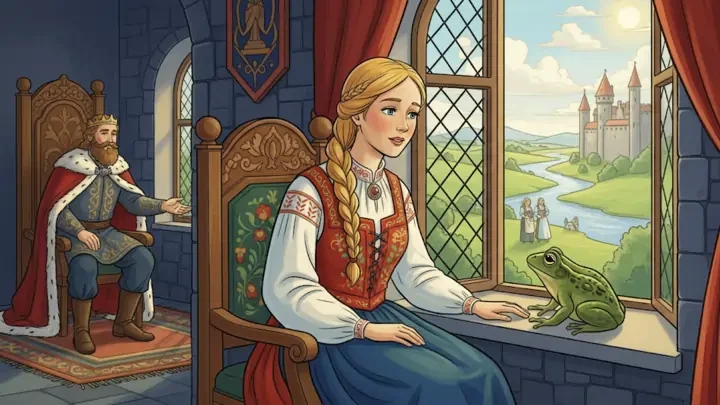
One spring day, while the water sparkled in the sunlight, a frog hopped up onto the windowsill and croaked in an unusually clear voice:
"Your wish will be granted. Before the year is out, you shall become a mother to a daughter."
The queen rose, trembling.
"Did you hear that, my king?" she whispered.
The king took her hand.
"May it be true."
And so it came to pass. Before the year was out, the queen gave birth to a beautiful little princess. Bells rang from every tower; people came from near and far with flowers and good wishes. The king at once proclaimed a great christening feast -- the greatest the kingdom had ever seen.
The Christening and the Fairies' Gifts
The great hall of the castle was decked with garlands and lights. The long tables gleamed with twelve golden plates, golden spoons, and crystal goblets. The king had invited twelve fairies, the wisest in the land, so that the princess would receive the finest gifts.
The fairies came one by one, light as morning mist, dressed in bright colors. The music fell silent, and they stepped forward to the cradle.
The first fairy bowed and said:
"I give you beauty, so that people will see the goodness in you."
The second laid her hand over the cradle:
"I give you kindness, so you will always do what is right."
The third smiled gently:
"I give you wisdom, so you will choose well when the time demands it."
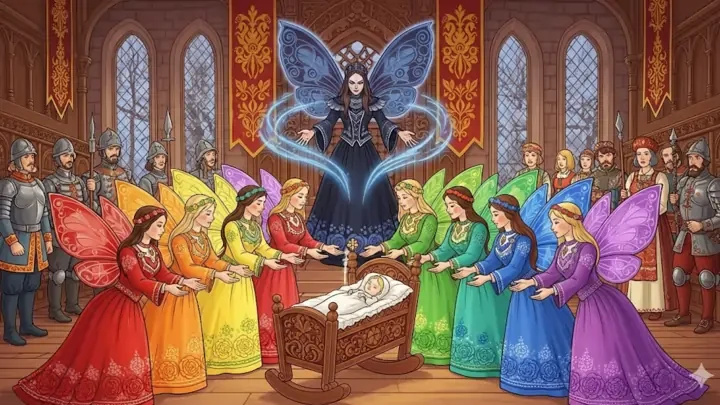
The next gifts were grace, patience, joy, composure, the gift of music, lightness of dance, eloquence, and a brave heart. Each gift was like a quiet light laid into the child's future.
Just as the eleventh fairy stepped back, and the twelfth raised her wand to speak, the great doors flew open. A cold wind swept through the hall and snuffed out several of the lights. In came the thirteenth fairy -- the one who had not been invited. The king had only twelve golden plates.
She looked from king to queen, from court to fairies, and went straight to the cradle.
"A feast without me?" she said, and her voice carried far.
"Then you shall have my gift too: when the princess turns fifteen, she shall prick herself on a spinning wheel -- and fall down dead!"
A gasp went through the hall. The queen gripped the edge of the cradle. The thirteenth fairy turned and vanished as suddenly as she had come.
The silence lay heavy before the twelfth fairy stepped forward. She looked at the parents and said calmly:
"The curse I cannot take away, but I can soften it. The princess shall not die -- she shall sleep for a hundred years, and then wake again."
"Then we shall burn every spinning wheel in the kingdom," said the king firmly.
"Do that," the fairy nodded. "But guard her with wisdom too."
Messengers carried the order to every corner. The spinning wheels were gathered and burned on bonfires. And yet everyone knows that old things can hide where the dust lies thick and doors are rarely opened.
Growing Up and the Foretold Day
The years passed. The princess grew up and became everything the fairies had wished for: kind, wise, and gentle. She learned to read, to play the lute, to dance courtly dances, and to speak with purpose and meaning. The servants and the court loved her. In the evenings, she often sat with the queen and read aloud.
"Mother," she asked once, "why are there no spinning wheels in the castle?"
The queen stroked her hair.
"It has been this way for many years, my child."
"But why?"
"Some things are best left untouched," the queen answered quietly, and closed the book.
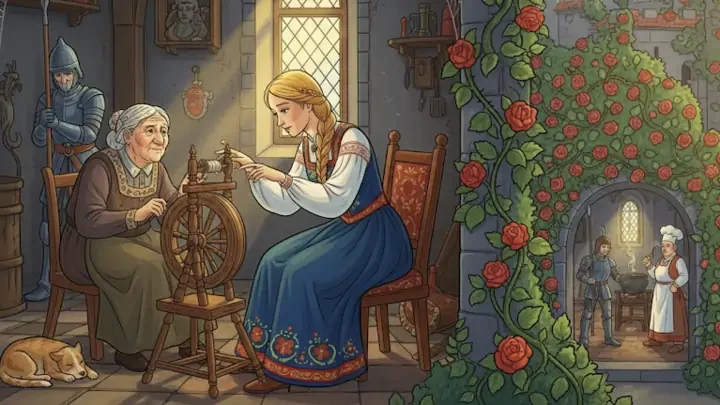
When the princess's fifteenth birthday came, the king and queen were away for a short while to dedicate a bridge in the town. The castle was quiet; the sun fell slanting through the windows. The princess walked through the halls with light steps.
"I've never seen everything here," she said to herself, and her eyes caught on a narrow spiral staircase she had never noticed before.
The steps creaked, the dust glittered in the light. At the top stood a door with a crooked key. She turned it; the lock sighed.
In a small chamber sat an old woman, spinning. The pedal moved steadily, the wheel whirred, the thread ran between her fingers.
"Good day, grandmother!" said the princess. "What are you doing?"
"I'm spinning, my child," answered the old woman, without stopping.
"I've never tried that before. May I take a closer look?"
"Gladly," she said, and lifted the spindle. "It isn't difficult once you know how."
The princess leaned in, curious.
"What fine thread! How do you get it--"
She reached out her hand, and at that very moment the point pricked her fingertip. A small "ow" -- and then everything went dark. She sank down silently and fell into a deep sleep.
At that same instant, sleep began to spread through the entire castle. A guard froze mid-step. The cook's ladle stopped still over the pot. A dog on the kitchen floor fell asleep with its nose on its paws. The candle flames stiffened into stillness and burned without flickering. The king and queen, who had just come through the gate, fell asleep where they sat.
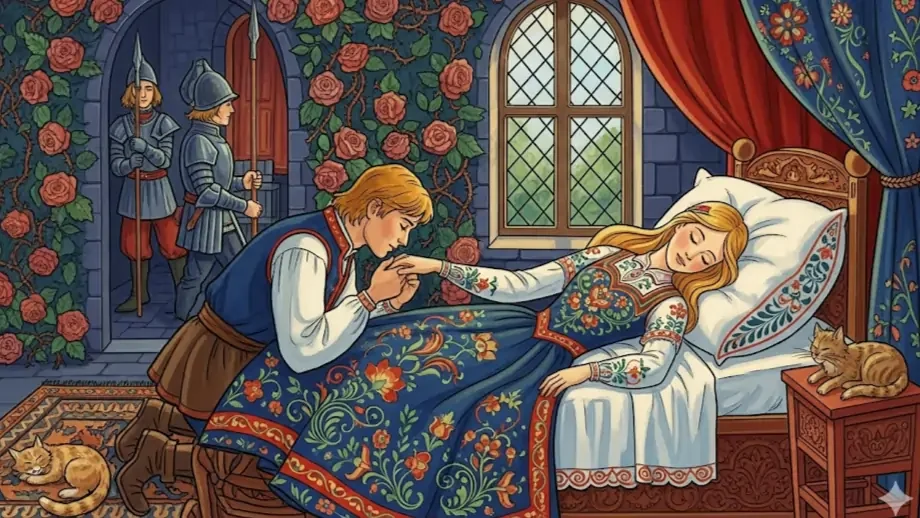
Around the castle, a dense hedge of thorns and roses shot up. The bushes grew and wove together, taller and thicker with every year, until the castle was hidden by green woods and sharp thorns. The story of the sleeping princess passed from mouth to mouth. Many princes tried to force their way through; the thorns caught them and drove them back. Time passed.
A Hundred Years and an Open Path
When a hundred years had passed, a young prince came riding that way. He heard an old man by the road tell of the castle behind the thorns and the girl who slept.
"Many have tried," said the old man, shaking his head.
"They didn't get far."
The prince looked toward the green wall.
"I want to see it with my own eyes."
He dismounted and walked toward the hedge. Just then, because the time had come, the thorns began to soften. The roses opened in silent bloom, and the branches slid aside, forming a path. The prince followed it in.
The castle lay still in warm light. He walked through the courtyard, past guards standing with half-raised spears, past a scribe with a quill hovering in the air, past a little page holding a silk ribbon between his fingers. Everything was just as it had been the moment sleep had fallen.
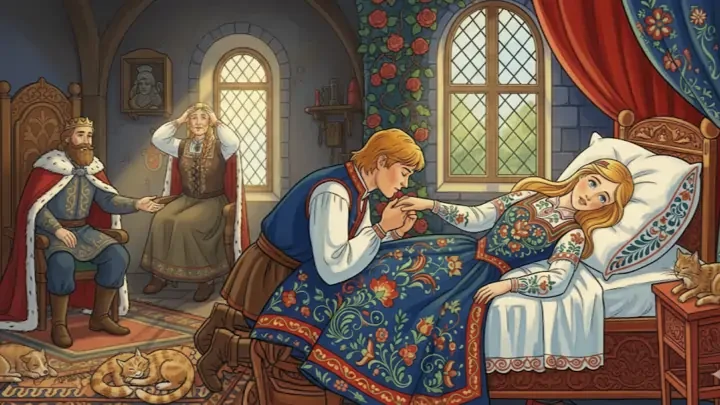
The stairs to the tower were narrow; the door stood ajar. In the room within lay Sleeping Beauty on a bed, pale and still, as if resting after a long day. The prince stood for a while and looked at her. Then he leaned down calmly and kissed her.
At that same moment, Sleeping Beauty opened her eyes. She drew a breath as if waking from a deep sleep, and saw the prince.
"Has the time come?" she asked softly.
"The time has come," he answered.
A gentle rustling sound moved through the whole castle, as if the walls were breathing out. The king and queen rose from their thrones. The guard's boot struck the stone floor. The cook's ladle stirred the pot again, and the scent of soup rose. Birds in the rafters shook out their feathers and picked up their song where they'd left off.
The king and queen came to the tower and embraced their daughter. The joy was great, and soon preparations began for a wedding. The halls were swept, the tablecloths laid, the musicians tuned their instruments. The prince and Sleeping Beauty stood together, and everyone rejoiced that time had kept its promise.
And they lived happily ever after. The story of Sleeping Beauty was never forgotten; it was told again and again, so that everyone would know that everything has its time -- both sleep and awakening.

The Tale of Sleeping Beauty: History, Origins, and Different Versions
The story of Sleeping Beauty is one of the world's most famous fairy tales, and has fascinated people for centuries. The tale of the princess who slept for a hundred years belongs to the tale type classified in folklore studies as ATU 410 ("The Sleeping Beauty"). Here we explore the history and the best-known versions of this timeless story.
The story of Sleeping Beauty has roots that stretch far back, and variants of it are found across many different cultures around the world. It has been interpreted and retold by many writers and artists over the centuries, from early Renaissance tales to modern films.
Versions and Adaptations (Culture, Music, and Film)
The tale of Sleeping Beauty has inspired countless works of art. Each version carries the core of the fairy tale with it, while adding its own nuances, characters, and messages.
The Classic Literary Versions
- Giambattista Basile: This early Italian version from the Pentamerone, "Sole, Luna e Talia," is a dark tale published in 1634. In it, the princess wakes when her children, Sun and Moon, suck the splinter out of her finger.
- Charles Perrault: In the French version, published in 1697, we find the iconic motif of the hedge of thorns and a courtly tone. Perrault also added a darker tale after the awakening that is rarely included in children's versions.
- The Brothers Grimm: In the Grimms' version, "Dornröschen," published in 1812 and the best-known book version in Norway, the youngest fairy softens the curse so that the princess sleeps for a hundred years, along with the entire court.
Ballet and Stage Art
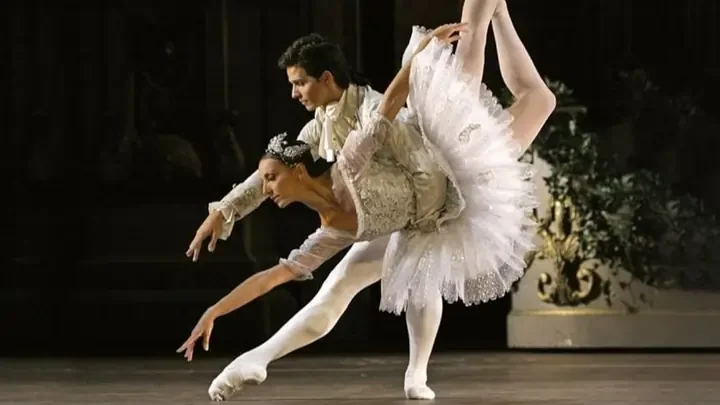
- Tchaikovsky's ballet: Sleeping Beauty became a stage classic with the ballet choreographed by Marius Petipa to music by Pyotr Tchaikovsky. It premiered in 1890. This ballet is one of the most performed in the world, with beautiful music, intricate choreography, and central characters like Princess Aurora and the evil fairy Carabosse.
The World of Animation: The Disney Classic
- Walt Disney's "Sleeping Beauty" (1959): The Disney film is perhaps the most iconic version for many people. The 1959 film introduces characters like the three good fairies, Flora, Fauna, and Merryweather, and the iconic villain Maleficent. The film is known for its stylized animation and its classic battle between good and evil.
In Disney's version, several elements change from Perrault and Grimm: the princess is named Aurora (and called "Briar Rose" in hiding), and she grows up with the three good fairies at her side: Flora, Fauna, and Merryweather. By including these three fairies by name, Disney reshaped the tale from Perrault and Grimm. The uninvited fairy is gathered into a single clear antagonist, Maleficent, who casts the curse at the christening.
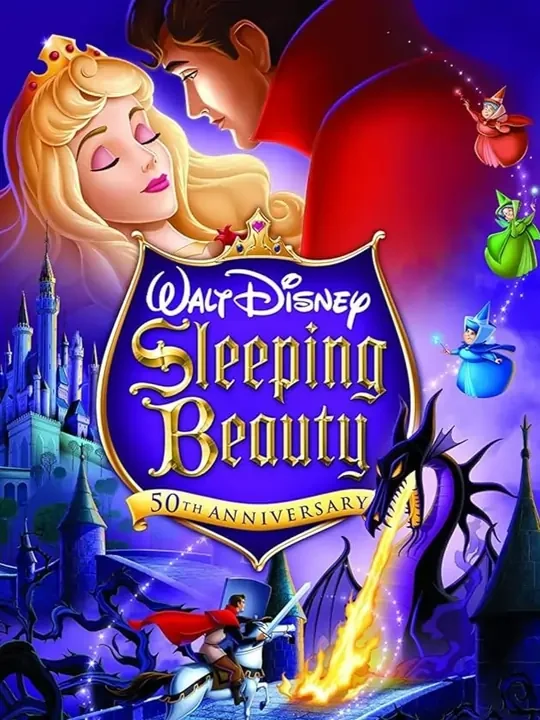
The story bends toward a romantic arc where "true love's kiss" breaks the spell (Perrault's darker epilogue, with its mother-in-law/cannibalism motif, is removed). Prince Phillip is given an active hero's role, including an epic battle against a dragon (Maleficent in dragon form) -- an action finale not found in Grimm. This addition makes Disney's Sleeping Beauty a unique and exciting interpretation. The number of fairies is reduced from twelve or thirteen to three, the humor is turned up through the fairies' everyday antics, and several of the darker motifs from the older texts are toned down to make the film more child-friendly.
Modern Interpretations and Children's Versions
Modern picture books and school editions: from the 20th century onward, child-friendly versions of the tale have been presented, avoiding the darker elements of the earliest stories. The focus lies on the power of the gifts, the deep sleep, the awakening, and a message of hope and endurance.


 English
 Norsk
Norsk Svenska
 Dansk
Dansk Deutsch
 Nederlands